
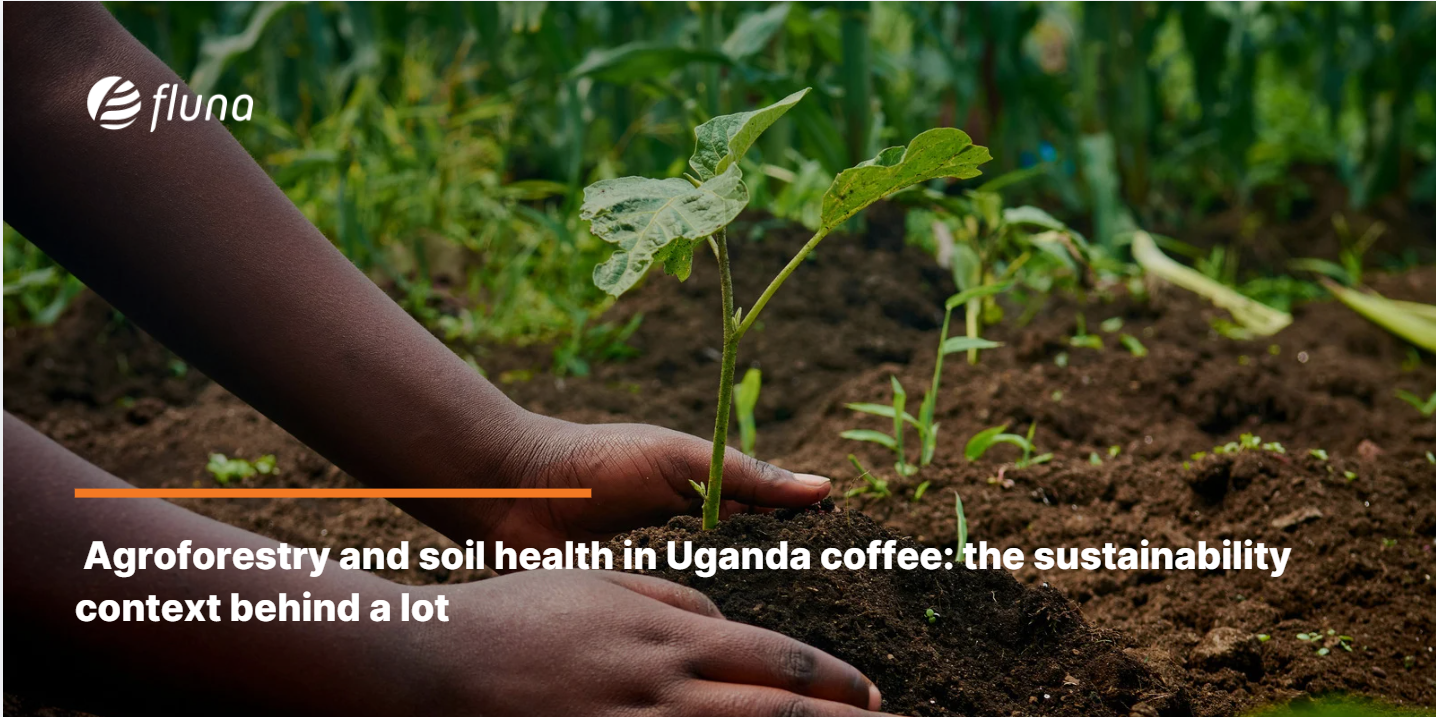
Agroforestry and soil health in Uganda coffee: the sustainability context behind a lot
By Sandra Nansbuga
Agroforestry and Soil Health in Uganda Coffee: The Sustainability Context Behind a Lot
Evaluating origin environmental stewardship, soil biological health, and canopy shade systems has become an essential quality and compliance priority for international coffee roasters, green buyers, and sustainability directors. Across Uganda's primary growing regions—from Mount Elgon's volcanic slopes to the Western Rwenzori foothills and the Lake Victoria Robusta crescent—traditional farming systems rely heavily on integrated agroforestry. Understanding how shade trees and organic soil management influence green coffee Uganda production allows commercial buyers to secure high-density beans, verify European environmental compliance, and support resilient smallholder ecosystems.
Agroecological farming principles documented by the FAO Agroecology Database demonstrate that polyculture shade canopies buffer coffee crops against global temperature extremes while enhancing organic soil carbon. In coordination with sustainability frameworks promoted by the UCDA / MAAIF and environmental standards from the Specialty Coffee Association, Ugandan agroforestry lots demonstrate measurable quality and conservation benefits.
Canopy Architecture and green coffee Uganda Soil Regeneration
Unlike intensive full-sun monocultures common in other origins, Ugandan smallholders traditionally intercrop coffee trees beneath multi-tiered shade canopies. The upper canopy typically features indigenous leguminous trees—such as Albizia, Cordia africana, and Ficus—which fix atmospheric nitrogen and provide continuous organic biomass through seasonal leaf fall. The mid-story canopy integrates matooke bananas, which supply dense shade, regulate ambient humidity, and conserve moisture in topsoil layers during dry spells.
This multi-stratum shade canopy plays a direct role in coffee cherry development. By filtering intense equatorial solar radiation, shade trees lower ambient temperatures by 3°C to 5°C, slowing cherry maturation. Slower ripening extends the photosynthetic filling phase, enabling trees to concentrate higher levels of complex sucrose sugars, organic acids, and minerals within the seed matrix. This prolonged metabolic development results in denser green coffee beans that display vibrant phosphoric acidity and complex floral sweetness on the cupping table.
Furthermore, agroforestry systems protect delicate topsoil from erosion along steep mountain slopes. Continuous natural leaf mulching enriches soil organic matter (SOM), fosters beneficial mycorrhizal fungi, and dramatically reduces the necessity for synthetic chemical fertilizers. This biological living soil foundation allows coffee trees to develop deep, drought-resilient root networks that sustain consistent yields across changing weather cycles.
Sourcing agroforestry-grown lots equips international buyers with verifiable farmgate traceability datasets required under modern deforestation-free supply chain mandates. Importers can substantiate their sustainability claims with empirical soil conservation and carbon sequestration metrics.
| Farming System Model | Canopy Cover (%) | Soil Organic Matter Retention | Cherry Ripening & Bean Density | EUDR & Environmental Compliance |
|---|---|---|---|---|
| Multi-Stratum Native Agroforestry | 40% – 60% shade canopy | High (>4.5% SOM; excellent microbial life) | Slow maturation; maximum cellular density | Full compliance; zero deforestation risk |
| Banana-Coffee Intercropping | 25% – 40% partial shade | Moderate – High (Rich mulch from banana leaves) | Even ripening; balanced sweet acidity | High smallholder food security & compliance |
| Full-Sun Monoculture | <10% shade coverage | Low (Prone to soil depletion & erosion) | Rapid ripening; lower screen uniformity | Requires intensive chemical input monitoring |
Roaster and importer guidance
Request Farmgate Soil and Canopy Audits: Require origin exporters to provide documentation on smallholder shade species and intercropping practices alongside traditional physical grading certificates.
Leverage Agroforestry in Retail Storytelling: Incorporate authentic agroforestry narratives—highlighting native shade trees, biodiversity protection, and soil carbon retention—into consumer packaging and brand marketing.
Adjust Roast Profiles for High-Density Shade Coffee: Apply deliberate convective heat energy during the drying phase to penetrate the compact cellular matrix characteristic of slow-ripened agroforestry beans.
Verify Deforestation-Free Compliance: Utilize farm polygon mapping provided through MAAIF to confirm that agroforestry lots originate from long-established regenerative plots without forest encroachment.
Support Cooperative Composting Programs: Partner with producer unions that convert coffee cherry pulp into organic compost, closing nutrient loops and reducing smallholder production costs.
Secure Forward Contracts for Shade Lots: Establish multi-season purchasing agreements with agroforestry cooperatives to insulate your roastery against climate-induced supply volatility.
Evaluate Biodiversity Co-Benefits: Factor native bird and pollinator conservation into corporate sustainability reports to demonstrate transparent origin impact to wholesale clients.
FAQ
Q: How does agroforestry improve green coffee quality in Uganda?
A: Shade trees reduce ambient temperatures, slowing cherry maturation and allowing coffee beans to develop higher sugar content, denser bean structures, and complex acidity.
Q: Why is banana-coffee intercropping common across Uganda?
A: Matooke banana plants provide natural shade, retain soil moisture during dry periods, prevent erosion, and provide smallholder farming families with essential food security and continuous income.
Q: Do Ugandan agroforestry systems comply with European deforestation regulations?
A: Yes. Traditional agroforestry represents stable, regenerative land use on long-established smallholder plots, complying fully with EUDR requirements when backed by digitized farm polygon mapping.
Sources: FAO Agroecology Database | UCDA / MAAIF | Specialty Coffee Association