
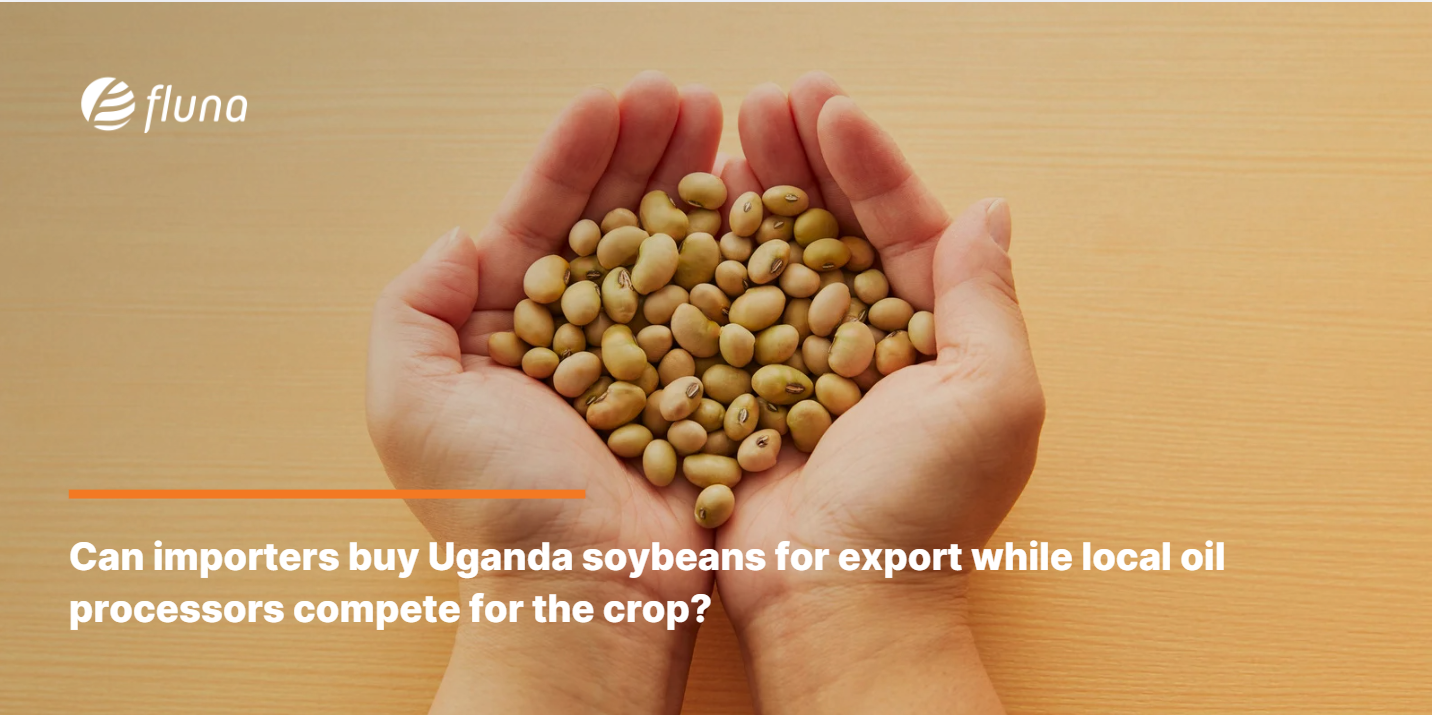
Can importers buy Uganda soybeans for export while local oil processors compete for the crop?
By Sandra Nansbuga
Can importers buy Uganda soybeans for export while local oil processors compete for the crop?
Yes, but volume is tight and it has to be secured early. Importers who want to buy Uganda soybeans for export are bidding against domestic processors that, according to the Daily Monitor (25 September 2026), are struggling to secure enough soybeans to meet demand for cooking oil and animal feed.
Who competes for Ugandan soybeans?
The Monitor reports that UOSPA, an industry association, says processors across the country are operating below capacity because of inadequate local supplies. UOSPA represents more than 100 edible-oil businesses.
One example is AgriNet, an agribusiness in Tororo District. It needs about 1,444 tonnes of oilseeds a year to run at full capacity but has raised its purchases from 120 tonnes to only 240 tonnes over the past year. It sources from farmers through about 12 agricultural hubs in the Busoga region. The Monitor figures cover oilseeds in total, so they do not give a soybean-only split.
How much Ugandan soybean actually reaches export buyers?
Less than it did. Uganda exported 21,484 tonnes of soybeans (HS 1201) worth US$15.9 million in 2023, according to UN Comtrade. The same database shows 10,549 tonnes worth US$6.3 million for 2024, per UN Comtrade, read from its public preview service and possibly subject to revision.
Both volume and value fell, so the drop is not a pricing effect alone. These are export figures reported by Uganda. The sources do not say what caused the fall, and this article does not attribute it to processor demand.
How can you buy Uganda soybeans for export and secure volume?
AgriNet, for example, specifies the varieties it needs, particularly those with high oil and protein content, the Monitor reports, and it sources through farmer hubs. An export buyer competing for the same grain should expect to compete on price and on reliability.
The Monitor reported on 25 September 2026 that AgriNet paid Shs2,300 per kilogramme for soybeans that season. That is one processor's price, not a market benchmark, but it shows the level an exporter's offer is measured against.
Practical steps follow from the reporting.
First, contract early with aggregators or farmer groups rather than buying on the spot. Second, recognise that UOSPA estimates some soybean farmers harvest only 300 to 400 kilogrammes per acre, against up to 2,500 kilogrammes per acre for improved varieties. Supply depends on seed quality, so ask suppliers which seed they use. Third, UOSPA proposes farmer centres with storage and drying equipment to bulk produce, which would be a natural counterparty for larger lots if they develop.
What quality and contract points should be agreed early?
The Monitor reports that some farmers deliver produce that is poorly dried or contaminated, and processors reject it or pay lower prices. Exporters face the same risk, so these points belong in the contract before a lot is booked.
| Point to agree | Why it matters | Source |
|---|---|---|
| Drying and moisture limit | Poorly dried produce is rejected or discounted | Monitor, 25 Sep 2026 |
| Contamination and foreign matter | Contaminated produce is rejected or discounted | Monitor, 25 Sep 2026 |
| Variety and oil or protein content | AgriNet specifies high oil and protein varieties | Monitor, 25 Sep 2026 |
Set the numeric limits, inspection method and rejection rights in writing with your own inspector. The reporting gives no Ugandan export specification, so none is quoted here.
Agree delivery timing and volume tolerance as well, since local processors are also short of supply.
Related reading: Fluna on green coffee sampling in Uganda and Fluna on cashew contract terms.
FAQ
Q: Did Uganda export soybeans in 2024?
A: Yes. UN Comtrade's public preview shows Uganda reported exports of 10,549 tonnes of soybeans (HS 1201) worth US$6.3 million for 2024, down from 21,484 tonnes in 2023.
Q: Are Ugandan processors short of soybeans?
A: According to the Monitor on 25 September 2026, UOSPA's executive director said processors across the country were operating below capacity because of inadequate local supplies.
Q: Why do some Ugandan soybean yields stay low?
A: UOSPA's executive director told the Monitor that some farmers recycle seed from earlier harvests and that yields keep falling. UOSPA estimates some farmers harvest only 300 to 400 kilogrammes per acre.
Sources: Daily Monitor | UN Comtrade | UN Comtrade