
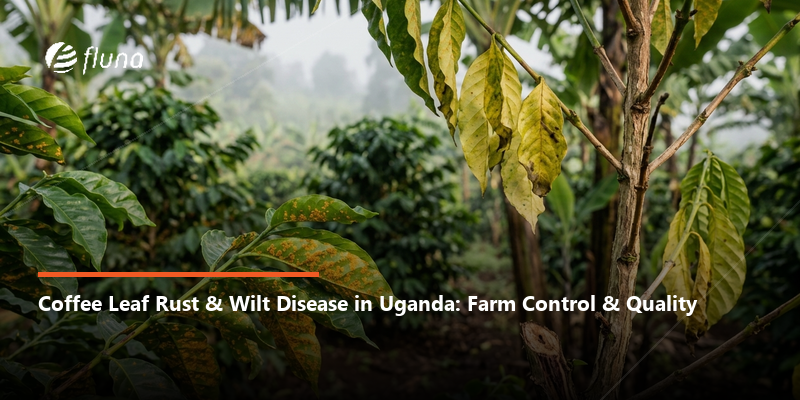
Coffee leaf rust and coffee wilt disease in Uganda: farm-level disease control and export quality
By Sandra Nansbuga
Coffee Leaf Rust and Coffee Wilt Disease in Uganda: Farm-Level Disease Control and Export Quality
Fungal phytopathologies represent one of the most substantial ongoing risks to smallholder crop yields and physical green coffee quality across East Africa. In Uganda, two distinct fungal pathogens dominate agronomic management: Coffee Leaf Rust (Hemileia vastatrix), which primarily challenges highland Arabica plantations, and the devastating vascular pathogen coffee wilt disease Uganda (tracheomycosis caused by Fusarium xylarioides), which specifically infects indigenous and commercial Robusta trees. For green coffee procurement specialists, understanding how farm-level disease containment protocols intersect with export dry-milling sorting explains lot density variations, defect rates, and long-term origin supply security.
Drawing on official management protocols from the Uganda Coffee Development Authority Robusta Handbook, plant health databases from CABI Plantwise, and agronomic variety evaluations from World Coffee Research, this guide analyzes how field disease management directly shapes export lot specifications.
Pathology and Transmission: Leaf Rust vs. Coffee Wilt Disease
The two diseases operate through fundamentally different infection pathways and produce contrasting physical impacts on coffee cherry development:
Coffee Leaf Rust (CLR): CLR attacks the foliage of Arabica coffee trees, particularly at elevations between 1,200 and 1,800 meters. The fungus produces yellow-orange powdery spore pustules on the undersides of leaves, causing premature defoliation. Without healthy photosynthetic leaf surface area, trees cannot adequately nourish developing cherry clusters. This starvation results in high proportions of empty, withered, or under-developed beans (known as floaters), lower bean density, and elevated secondary defect tallies in green Arabica lots.
Coffee Wilt Disease (CWD): CWD is a soil-borne vascular wilt fungus affecting *Coffea canephora* (Robusta). The pathogen enters the plant through root wounds or pruning cuts, colonizing the water-conducting xylem vessels. Infected Robusta trees display curling, yellowing leaves that dry and remain hanging on branches, black vascular necrosis in the stem wood, and total tree mortality within months. Because vascular blockage abruptly halts sap flow, cherries on infected trees dry prematurely into shriveled, blackened mummies, introducing severe black bean defects if harvested inadvertently.
| Pathological Dimension | Coffee Leaf Rust (Hemileia vastatrix) | Coffee Wilt Disease (Fusarium xylarioides) | Export Lot Quality Consequence |
|---|---|---|---|
| Primary Host & Agro-Zone | Arabica (Mount Elgon, Rwenzori, West Nile) | Robusta (Central, Western, and Lake Victoria basin) | Determines regional origin vulnerability |
| Mode of Transmission | Airborne and rain-splashed fungal urediniospores | Soil-borne spores, pruning machetes, root contact | CWD causes total tree death; CLR causes defoliation |
| Physical Bean Defect Impact | Immature, hollow, low-density beans; light screen sizes | Full black beans, sour cherries, shriveled peaberries | Increases primary defect counts and roasting quakers |
| Farm-Level Control Protocol | Copper fungicides, shade regulation, Catimor crosses | Strict uprooting, on-site burning, CWD-r clonal lines | Farm sanitation prevents diseased cherry entry into supply |
Agronomic Interventions and Export Mill Remediation
To curb Coffee Wilt Disease, the National Coffee Research Institute (NaCORI) developed and distributed seven certified CWD-resistant clonal Robusta varieties (known as CWD-r lines 1 through 7). Farmers are trained to uproot infected trees immediately and burn them on-site, as transporting infected wood spreads fungal spores across farms. Machetes and pruning shears must be flame-sterilized or dipped in chlorine bleach between trees to halt mechanical transmission.
At the export dry mill, rigorous physical sorting protocols eliminate the residual defect fallout from disease-stressed farms:
1. Water Floatation Intake: During primary washing station cherry reception, low-density floaters resulting from leaf-rust defoliation are skimmed off water channels before depulping.
2. Densimetric Gravity Tables: Milled green beans with low internal mass caused by premature wilt desiccation are separated and directed away from export grades.
3. Bichromatic Optical Sorting: High-speed Sortex color sorters inspect and reject full black and discolored beans caused by vascular blight, ensuring export lots maintain clean physical purity.
FAQ
Q: What is the primary difference between Coffee Leaf Rust and Coffee Wilt Disease?
A: Coffee Leaf Rust is a foliar fungal disease affecting Arabica foliage, while Coffee Wilt Disease is a fatal soil-borne vascular pathogen that attacks the vascular system of Robusta trees.
Q: How does Coffee Leaf Rust affect green coffee physical quality?
A: Defoliation prevents cherries from filling properly, producing low-density, hollow beans that roast unevenly and yield lower screen size distributions.
Q: What are CWD-r varieties and why are they important?
A: CWD-r varieties are cloned Robusta cultivars bred by Uganda's NaCORI specifically for genetic resistance to *Fusarium xylarioides*, safeguarding long-term national Robusta production.
Sources: UCDA Robusta Coffee Handbook | CABI Plantwise | World Coffee Research