
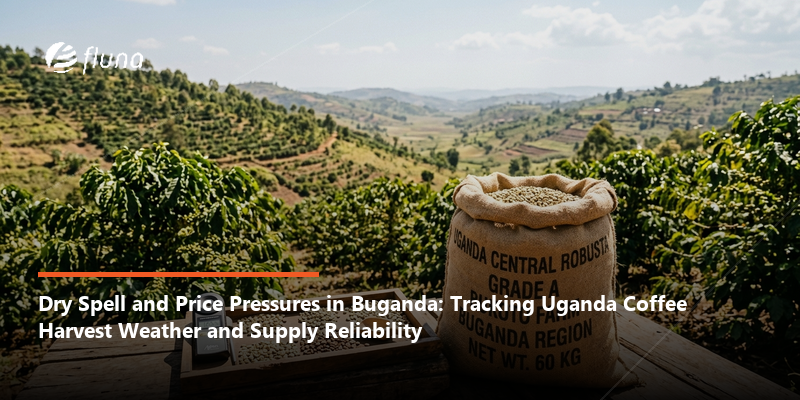
Dry spell and low prices squeeze coffee farmers in Buganda: supply and quality implications
By Sandra Nansbuga
Dry Spell and Price Pressures in Buganda: Tracking Uganda Coffee Harvest Weather and Supply Reliability
Central Uganda's Buganda region—encompassing critical Robusta production hubs across Masaka, Mpigi, Luwero, and Mukono—faces a challenging confluence of severe dry spells and shifting local market pricing. Green coffee procurement teams monitoring Uganda coffee harvest weather must evaluate how extended moisture deficits in the Lake Victoria basin affect flowering development, cherry sizing, and smallholder harvesting behavior. Understanding these regional agro-climatic dynamics is essential for managing forward contract timelines and anticipating green bean quality variations.
Recent agricultural reports published by Ugandan trade publications and Daily Monitor highlight how prolonged rainfall deficits stress smallholder Robusta orchards. In coordination with regional data from the UCDA / MAAIF and global market assessments from the International Coffee Organization, commercial buyers must adopt proactive origin strategies to secure contracted volumes.
Climatic Stress, Farmer Liquidity, and Uganda Coffee Harvest Weather
The Buganda coffee belt represents the historical heartland of Ugandan Robusta production, delivering high-density, neutral-profile beans that anchor international commercial espresso blends. However, recent unseasonal dry spells during critical bean-filling periods have limited cherry expansion on the tree. Moisture-stressed trees shed premature cherries or produce smaller, lighter beans. This environmental stress directly reduces the outturn of high-value Screen 18 and Screen 17 beans while increasing the proportion of smaller Screen 15 and Screen 12 grades.
Simultaneously, downward pressure on local farmgate prices has squeezed smallholder profit margins. When farmgate revenues decline following a price correction, smallholder families face acute cash flow shortages. This liquidity squeeze frequently leads farmers to reduce investments in essential farm inputs, such as organic mulching, compost application, and labor for selective red cherry picking. In severe instances, farmers delay farm maintenance or harvest prematurely to meet immediate household financial obligations.
For international buyers and roasters, these twin pressures introduce supply chain risks. Reduced screen sizes alter roasting thermodynamic profiles, while delayed post-harvest processing at rural collection points increases the risk of moisture variability and mold contamination on communal drying yards.
| Regional Stress Factor | Agronomic & Farmgate Impact | Green Bean Physical Consequence | Buyer Supply Chain Risk | Actionable Origin Strategy |
|---|---|---|---|---|
| Extended Seasonal Dry Spell | Severe soil moisture depletion during cherry filling | Lower cellular density; higher percentage of small beans | Reduced availability of premium Screen 18 export lots | Adjust blend formulations to incorporate Screen 15 lots |
| Farmgate Price Contraction | Reduced smallholder liquidity and input investment | Inconsistent cherry sorting; higher defect percentages | Variable cup profile; increased quakers and sour beans | Pay quality-linked farmgate premiums to certified cooperatives |
| Unpredictable Rainfall Timing | Disrupted flowering and staggered cherry ripening | Uneven moisture content across drying yard batches | Shipment delays and elevated transit mold vulnerability | Enforce strict water activity (≤0.60 aw) testing before stuffing |
What this means for buyers
Monitor Regional Harvest Calendars and Rainfall Data: Track microclimate weather reports across Central Uganda districts (Masaka, Luwero, Mpigi) to anticipate crop timing shifts and screen size distributions before committing to forward contracts.
Diversify Grade Sourcing Across Screen Sizes: When weather shocks reduce Screen 18 yields, flexibly incorporate high-quality Uganda Robusta Screen 15 lots into commercial blend recipes to maintain supply continuity without sacrificing crema performance.
Enforce Rigorous Pre-Shipment Defect Screening: Implement strict visual and optical sorting checks on Buganda lots to identify and reject immature quakers or defective beans caused by rushed harvesting during dry intervals.
Support Cooperative-Level Water Catchment and Mulching: Partner with exporters that co-invest in smallholder agroforestry shading and water-harvesting infrastructure to build long-term climate resilience across Central Ugandan farms.
Incorporate Flexible Shipment Windows into Contracts: Allow two to three weeks of delivery flexibility during anomalous weather seasons to accommodate delayed cherry maturation and extended solar drying times.
Verify Strict Moisture Content at Export Staging: Demand calibrated moisture meter certificates (11.0% to 12.5%) and water activity checks (≤0.60 aw) at container stuffing to prevent quality loss during ocean freight.
Strengthen Direct Exporter Partnerships: Secure multi-season purchasing agreements with well-capitalized Ugandan exporters who provide working capital advances to smallholder cooperatives, stabilizing local cherry aggregation.
FAQ
Q: How do dry spells affect Robusta coffee quality in Buganda?
A: Extended dry spells reduce bean sizing, leading to lower yields of Screen 18 beans and an increase in Screen 15 or peaberry beans, while potentially reducing bean density.
Q: Why do fluctuating farmgate prices impact coffee quality?
A: Lower farmgate prices reduce farmer liquidity, leading to cutbacks in weeding, organic fertilizer application, and selective harvesting, which can increase defect rates.
Q: What can buyers do when weather reduces large screen size availability?
A: Buyers can adjust roasting parameters and blend formulations to utilize well-graded Screen 15 Robusta, which delivers comparable neutral body and crema at competitive prices.
Sources: Daily Monitor / Independent Uganda | UCDA / MAAIF | International Coffee Organization