
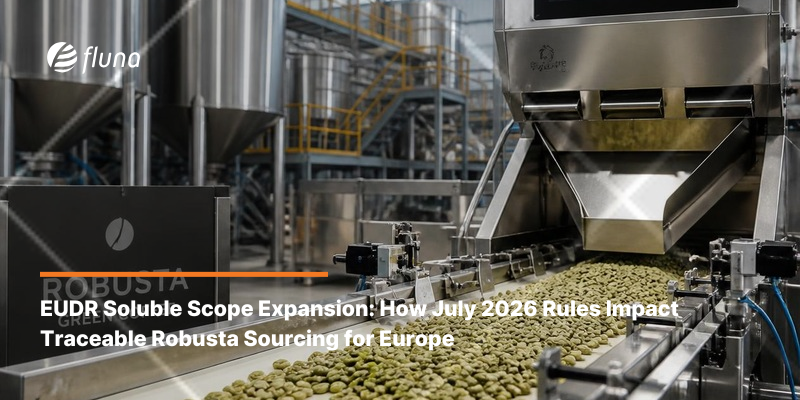
EUDR Soluble Scope Expansion: How July 2026 Rules Impact Traceable Robusta Sourcing for Europe
By Sandra Nansbuga
EUDR Soluble Scope Expansion: How July 2026 Rules Impact Traceable Robusta Sourcing for Europe
The enforcement of the European Union Deforestation Regulation across downstream coffee derivatives requires industrial food manufacturers and instant coffee processors to verify origin plot coordinates for all soluble extracts. Because canephora provides the primary high-yield feedstock for spray-dried and freeze-dried manufacturing, this regulatory mandate has transformed European green procurement. Understanding this expanded EUDR coffee product scope allows commercial buyers to secure compliant Ugandan Robusta streams and prevent supply disruptions at European borders.
Under Annex I of Regulation (EU) 2023/1115 published on EUR-Lex, statutory due diligence applies not only to raw green beans (HS Code 0901) but also to coffee extracts, essences, and concentrates (HS Code 2101). Regulatory timeline updates from the European Commission confirm that industrial operators placing derived coffee preparations on the EU single market must link finished production batches to validated farmgate GPS coordinates.
Industrial Sourcing Implications of the EUDR Coffee Product Scope
Historically, commercial soluble coffee manufacturing operated under high-volume bulk aggregation models where green beans from diverse, unmapped dealer networks were blended at extraction facilities. However, EUDR strictly prohibits mass balance accounting and volume blending with unverified beans. Every metric ton of green coffee entering an extraction plant must possess a verified Due Diligence Statement (DDS) confirming that raw cherries were harvested on land not subject to deforestation after December 31, 2020.
If an unmapped lot is mixed into an industrial extraction run, the entire resulting batch of instant coffee becomes legally contaminated and subject to mandatory commercial product recalls. In Uganda, Africa's leading Robusta producer, national farmer registration and farmgate geolocation mapping coordinated by the UCDA provide European buyers with audited digital data packages. Because Ugandan Robusta yields superior soluble solids extraction efficiency (typically 42% to 46% soluble mass conversion), European processors are prioritizing direct forward contracts with integrated Ugandan exporters.
These integrated exporters operate dedicated buying stations, centralized dry mills, and identity-preserved warehousing in Kampala. By establishing physical segregation protocols from farmgate collection to container stuffing, Ugandan suppliers provide European soluble manufacturers with uncompromised chain-of-custody documentation. Furthermore, satellite canopy overlay verification is conducted on every registered farm polygon before export clearance, ensuring complete legal certainty for European customs authorities.
This verified origin pipeline insulates European industrial manufacturers from regulatory liability and protects commercial retail brands against expensive supply chain interruptions and border rejections.
| Product Category | Raw Green Robusta (HS 0901 11) | Soluble Instant Granules (HS 2101 11) | Liquid Coffee Concentrates (HS 2101 12) |
|---|---|---|---|
| EUDR Annex I Status | Direct primary commodity coverage | Mandatory derived product coverage | Mandatory derived product coverage |
| Farm Geolocation Mandate | Points (<4 ha) or Polygons (≥4 ha) | Full upstream farm coordinates required | Full upstream farm coordinates required |
| Chain of Custody Rule | Physical segregation / identity preserved | Physical segregation (No mass balance) | Physical segregation (No mass balance) |
| Primary Risk Factor | Port customs documentation delay | Batch recall from European retail shelves | Factory processing line audit failure |
| Manufacturer Action | Audit origin export documentation | Contract verified traceable Robusta supply | Integrate TRACES NT XML payloads |
What this means for buyers
Factory Feedstock Traceability Audits: European extraction plants must conduct rigorous upstream due diligence on all incoming green Robusta lots. Purchasing non-geolocated commercial coffee exposes finished soluble product lines to statutory import bans and severe corporate penalties reaching at least 4% of EU annual turnover.
Multi-Year Sourcing Agreements: Soluble manufacturers should transition from volatile spot market procurement to multi-year forward supply partnerships with established Ugandan exporters. Securing mapped farmer networks guarantees raw material availability and shields commercial budgets from compliance-driven origin price premiums.
Automated Data Infrastructure: Integrate digital supply chain mapping tools that ingest spatial coordinate payloads (XML and JSON formats) directly into enterprise resource planning software. Ensuring data compatibility with the EU Information System eliminates administrative bottlenecks during import declaration filings and customs audits at discharge ports across Europe.
FAQ
Q: Are instant coffee products exempt from EUDR plot-level traceability?
A: No. Under Annex I (HS Code 2101), soluble and instant coffee products are fully covered and require the exact same plot-level GPS coordinates and deforestation due diligence as raw green coffee beans.
Q: Can European manufacturers use mass balance accounting for soluble coffee?
A: No. The EUDR strictly prohibits mass balance accounting. Processors must maintain complete physical segregation to ensure every finished soluble batch corresponds directly to compliant, geolocated farm plots.
Q: Why is Ugandan Robusta preferred for compliant soluble extraction?
A: Uganda provides large commercial volumes of high-yielding Robusta supported by comprehensive national farmer registration and polygon mapping, giving European processors reliable, audit-ready compliance data.