
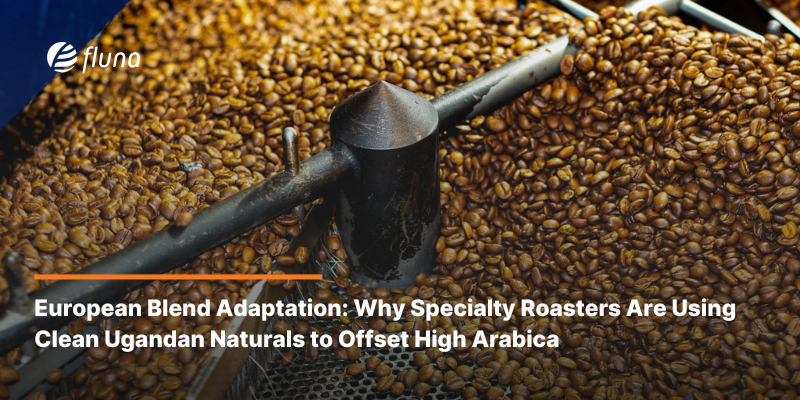
European Blend Adaptation: Why Specialty Roasters Are Using Clean Ugandan Naturals to Offset High Arabica
By Sandra Nansbuga
European Blend Adaptation: Why Specialty Roasters Are Using Clean Ugandan Naturals to Offset High Arabica
European roasters are increasingly incorporating clean, high-altitude Ugandan Natural Robustas into espresso blends to protect operating margins against high Arabica commodity prices while maintaining dense crema and rich mouthfeel. By sourcing lots that meet the 80-point threshold for Fine Robusta, roasters can integrate 15% to 30% canephora without introducing harsh, rubbery, or astringent defects into the cup. This structural blending adaptation allows European roasters seeking Fine Robusta to achieve optimal espresso extraction physics, enhance foam persistence, and stabilize unit production costs.
Global coffee market monitoring from the International Coffee Organization highlights sustained price volatility across benchmark Arabica contracts, prompting procurement teams in major European consumer markets to reformulate blend components. Historically, commercial roasters in Southern and Western Europe utilized standard commodity Robusta primarily as a cost-cutting filler. However, specialty and premium commercial roasters across Italy, Germany, and the United Kingdom are now shifting toward specialty-grade canephora to combine disciplined cost management with elevated sensory performance.
Uganda provides distinct agro-ecological and botanical advantages for this blend adaptation. According to the UCDA, Robusta accounts for approximately 80% of national coffee output, with indigenous highland varieties cultivated at elevations between 1,100 and 1,500 meters above sea level across the Lake Victoria basin and western producing regions. These higher growing altitudes foster slower cherry maturation and greater natural sugar accumulation compared to lowland Robusta origins. When harvested at peak ripeness, dried on raised beds, and optically sorted, Ugandan Naturals yield Screen 18 and Screen 15 lots that exhibit clean profiles of dark cocoa, toasted hazelnut, cane sugar, and dried fruit.
From an extraction standpoint, Robusta beans possess higher soluble solid content and lower total lipid levels (typically 10% to 11% compared to 15% to 17% in Arabica). In espresso brewing, excessive lipids destabilize the foam matrix, whereas lower lipid concentrations and higher polysaccharide density generate a thicker, more elastic, and longer-lasting crema. Under Coffee Quality Institute grading protocols, Fine Robusta lots must achieve a cupping score of 80 points or higher with zero primary defects in a 350-gram green sample, ensuring that physical extraction benefits do not compromise the aromatic profile of the finished blend.
| Quality & Technical Attribute | Standard Commercial Robusta | CQI Fine Ugandan Natural Robusta |
|---|---|---|
| Cupping Score (CQI Protocol) | Below 80.0 points | 80.0+ points (Specialty grade) |
| Defect Tolerance (350g sample) | High defect counts permitted | Zero primary defects; max 5 secondary |
| Sensory Flavor Profile | Rubbery, woody, harsh bitterness | Dark chocolate, hazelnut, dried fruit |
| Extraction & Crema Behavior | Volatile crema, bitter astringency | Dense, elastic crema; heavy body |
| Blend Inclusion Ratio | Low-cost bulk commercial blends | 15% to 30% in specialty espresso |
What this means for buyers
Formulation Optimization: Roasters can integrate 15% to 25% clean Ugandan Natural Robusta into seasonal espresso formulations to mitigate Arabica price spikes. This inclusion percentage reinforces body and stabilizes crema without overpowering delicate floral or citric Arabica notes.
Physical Quality Specifications: Buyers should contractually specify Screen 18 or Screen 15 preparation with strict CQI Fine Robusta defect tolerances. Sourcing uniform screen sizes ensures predictable thermal transfer during roasting, preventing uneven roast development across species.
Green Coffee Moisture Control: Because highland Ugandan Naturals carry higher bean density, procurement managers must enforce green coffee moisture parameters between 10.5% and 12.0% at origin stuffing to prevent water activity spikes and maintain cup sweetness during ocean transit.
Forward Contract Execution: Sourcing high-scoring Ugandan Naturals requires direct engagement with origin exporters prior to harvest peaks. Securing forward volume commitments for specialty lots avoids competition with commercial buyers purchasing standard FAQ grades.
Frequently Asked Questions
How does Fine Robusta improve espresso crema stability in European blends?
Fine Robusta contains lower total lipids and higher soluble solids than Arabica. During 9-bar espresso extraction, lower lipid levels prevent the breakdown of the liquid-gas emulsion, resulting in a significantly thicker, more elastic, and longer-lasting crema layer that enhances visual presentation and mouthfeel.
What quality standards define CQI Fine Robusta?
According to the Coffee Quality Institute, a green coffee lot must score 80 points or higher on the standardized sensory evaluation scale, contain zero primary defects and no more than 5 secondary defects in a 350-gram sample, and have no more than 3 quakers per 100 grams of roasted coffee.
What flavor profile do clean Ugandan Natural Robustas contribute to espresso?
Unlike commercial Robusta, clean Ugandan Naturals grown at high elevations contribute sweet, structured notes of dark cocoa, roasted nuts, cane sugar, and dried stone fruit, providing body and crema without harsh, rubbery, or phenolic off-flavors.