
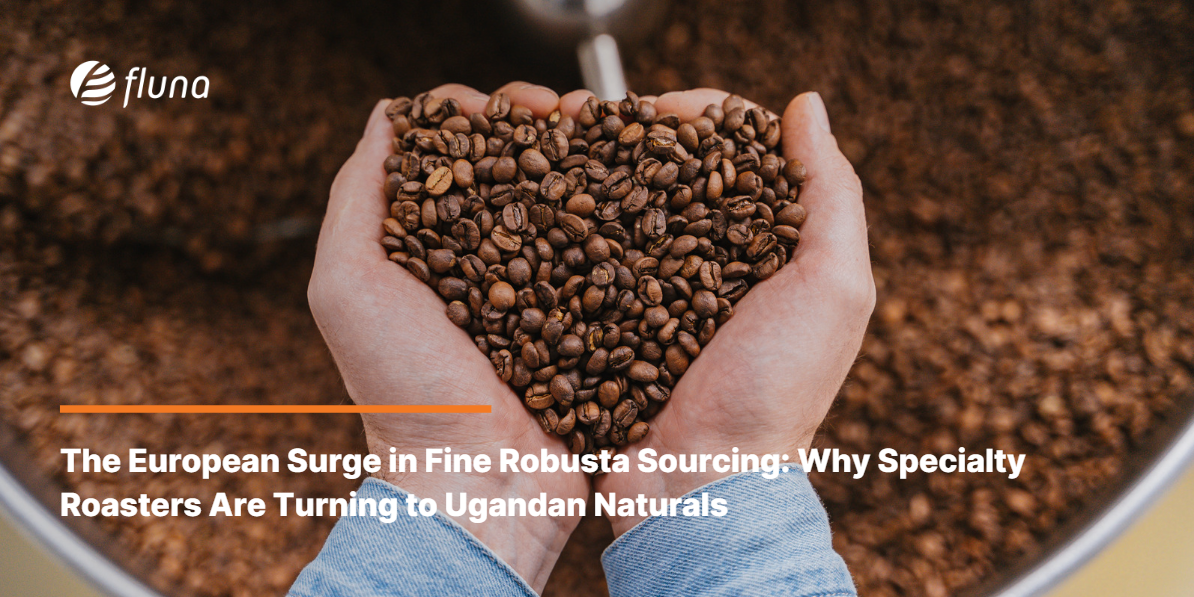
The European Surge in Fine Robusta Sourcing: Why Specialty Roasters Are Turning to Ugandan Naturals
By Sandra Nansbuga
The European Surge in Fine Robusta Sourcing: Why Specialty Roasters Are Turning to Ugandan Naturals
European specialty roasters are increasingly offering single-origin and quality-graded Robusta alongside Arabica, a shift the EU's own trade promotion agency attributes to rising global coffee prices and growing attention to production quality. Uganda is positioned at the center of that shift because it co-developed, with the Coffee Quality Institute, the industry's first formal standard for grading Robusta on the same "Fine" quality tier historically reserved for specialty Arabica.
What has changed in the market
According to CBI, the Netherlands' government trade promotion agency, in its market analysis of European Robusta demand, Robusta coffee has traditionally been seen as lower quality, but that perception is changing: high-end coffee shops now sell single-origin Robusta espressos, and specialty roasters are offering quality Robusta beans, driven by rising global coffee prices, climate pressure on Arabica-growing regions, and increased attention to production quality. The same source identifies Germany, Italy, and Spain as Europe's three largest Robusta markets, and notes that roasters commonly blend Arabica with Robusta to manage production costs, which links directly to how elevated Arabica pricing affects blend decisions.
The quality infrastructure behind this shift traces back to Uganda specifically. CQI's own account of its work in Uganda states that in 2014, the Uganda Coffee Development Authority and CQI published the industry's first comprehensive guide of standards and procedures defining Fine Robusta coffee, built on evaluation principles similar to those used for specialty Arabica, and that Uganda today has the largest pool of trained Fine Robusta cuppers of any coffee-producing nation. Under the CQI/UCDA Fine Robusta classification system, green coffee must have zero primary defects and no more than five secondary defects in a 350-gram sample, with a final cupping score of 80 or above, to qualify for the Fine Robusta tier, a materially stricter bar than standard commercial-grade Robusta.
On pricing context, UCDA's Monthly Coffee Report for January 2026 shows Washed Robusta as the highest-priced Robusta category that month at US$5.04 per kilogram, ahead of Screen 17 at US$4.45/kilogram, while the report also cites USDA data showing the global coffee market has faced a fifth consecutive year of falling ending stocks, with the ICO monthly composite price index having nearly tripled over the corresponding period.
What this means for buyers
Quality-graded Robusta is a genuine pricing lever, not just a marketing angle. With Arabica supply remaining tight by historical standards and Robusta commanding higher prices for washed and higher-screen lots, buyers looking to protect blend margins without sacrificing cup quality have a real option in CQI/UCDA-graded Fine or Premium Robusta rather than defaulting to commodity-grade material. This is a substitution decision that should be evaluated on cupping score and defect count, not price alone.
"Naturals" and "washed" are not interchangeable when quality is the selection criterion. Uganda's traditional Robusta processing produces Kiboko, dried cherry that is naturally processed, which differs in cup profile from the smaller-volume Washed Robusta category that commanded the highest price in UCDA's January 2026 data. Buyers should specify which processing method they actually want cupped and priced, since assuming "Ugandan Robusta" is a single uniform product risks a mismatch between the sample cupped and the container shipped.
Fine Robusta certification is a sourcing filter, not a guarantee on every lot. Uganda having the largest pool of trained Fine Robusta cuppers globally is a national capability, not a statement that every Ugandan Robusta lot meets the Fine Robusta defect and cupping thresholds. Buyers should request the specific green and cupping defect counts for a lot against the CQI/UCDA thresholds rather than treating "Ugandan Robusta" as shorthand for "Fine Robusta."
FAQ
What is Fine Robusta, and who defines the standard?
Fine Robusta is a quality classification developed jointly by the Coffee Quality Institute and the Uganda Coffee Development Authority, requiring zero primary defects, no more than five secondary defects per 350-gram sample, and a cupping score of 80 or above.
Why are European roasters showing more interest in quality Robusta?
CBI, the Netherlands' government trade promotion agency, attributes this to rising global coffee prices, climate pressure affecting Arabica supply, and growing attention to coffee production quality among specialty roasters.
Which Robusta category commanded the highest price in Uganda's most recent export data?
UCDA's January 2026 Monthly Coffee Report shows Washed Robusta at US$5.04 per kilogram as the highest-priced Robusta category that month, ahead of Screen 17 at US$4.45/kilogram.
Sources
Uganda, Coffee Quality Institute (CQI)
Classification system of Fine Robusta coffee according to CQI/UCDA
Uganda Coffee Development Authority, Monthly Coffee Report, January 2026
Sources: CBI, the Netherlands' government trade promotion agency, in its market analysis of European Robusta demand | CQI's own account of its work in Uganda | CQI/UCDA Fine Robusta classification system | UCDA's Monthly Coffee Report for January 2026 | Uganda, Coffee Quality Institute (CQI)