
Green coffee packing for export: GrainPro, jute bags and container conditions that protect Ugandan quality
By Sandra Nansbuga
Green Coffee Packing for Export: GrainPro, Jute Bags, and Container Conditions That Protect Ugandan Quality
Maintaining physical moisture stability and preserving complex cup profiles during long-distance maritime transit is a critical priority for green coffee importers, specialty roasters, and origin exporters. Because coffee exported from landlocked Uganda undergoes multimodal transit across the Northern Corridor before spending weeks in ocean container holds, environmental fluctuations pose serious risks to bean cellular integrity. Understanding advanced export packaging options and the factors that dictate Uganda green coffee export quality empowers buyers to prevent condensation damage, eliminate moisture fading, and ensure harvest-fresh cup quality at destination.
Technical packaging guidelines developed by GrainPro demonstrate that hermetic barrier technology effectively arrests hygroscopic moisture exchange and protects raw beans from atmospheric humidity. In coordination with statutory export standards enforced by the UCDA / MAAIF and storage standards established by the Specialty Coffee Association, Ugandan dry mills deploy multi-layer barrier systems tailored for long-haul international shipping.
Packaging Technologies and Uganda Green Coffee Export Quality Preservation
Traditional single-layer jute burlap sacks (standard 60kg net weight) offer excellent breathability and mechanical stacking strength. However, natural jute fibers are permeable to external moisture, ambient odors, and marine humidity. During the overland journey from Kampala to the Port of Mombasa, green coffee encounters humid tropical coastal climates where relative humidity regularly exceeds 85%. Without protective barriers, green coffee absorbs moisture, raising water activity above safe thresholds (0.60 aw) and accelerating lipid oxidation.
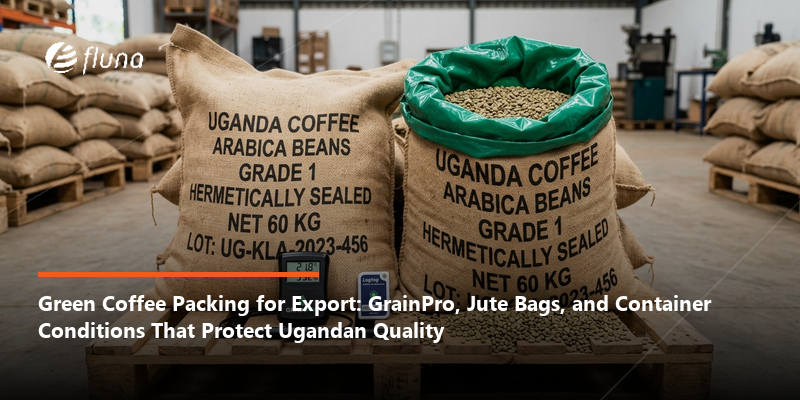
To eliminate this vulnerability, specialty exporters insert high-barrier hermetic liners—such as multi-layer polyethylene GrainPro or Eco-Tact bags—inside standard jute sacks. Hermetic liners create a modified micro-atmosphere that locks in internal bean moisture (ideally between 10.5% and 12.0%) while preventing external vapor ingress, insect infestation, and mold development. For high-scoring washed Bugisu AA Arabica and Western Fine Robusta, hermetic packaging preserves delicate organic acids and floral aromatics for over twelve months in destination storage.
Beyond individual bag liners, container-level climate controls play a decisive role. Fitting 20-foot shipping containers with multi-pole calcium chloride desiccants and thermal insulation liners prevents "container sweat"—the condensation that forms on steel container ceilings during trans-equatorial temperature shifts—safeguarding entire 19.2-metric-tonne consignments.
Implementing rigorous packaging specifications during export contract drafting guarantees that green coffee maintains pristine physical and sensory characteristics from origin milling to final batch roasting. Roasters who insist on hermetic packaging protect their inventory against age-related fading and preserve the distinct flavor nuances developed through careful origin processing.
| Packaging Method | Moisture & Vapor Barrier Protection | Ingress Protection (Pests/Odors) | Target Ugandan Coffee Grade | Destination Shelf-Life Longevity |
|---|---|---|---|---|
| Standard Jute Burlap Bag | Low (Permeable to ambient humidity) | Basic physical debris protection only | Standard commercial FAQ Robusta Screen 15 | 3 – 6 Months before sensory fade |
| Jute + GrainPro Hermetic Liner | Maximum (Impermeable vapor barrier) | Full hermetic pest and odor isolation | Bugisu AA, Fine Robusta, Micro-Lots | 12 – 18 Months fresh cup retention |
| Full-Container Thermal Liner Foil | High (Reflects radiant heat & condensation) | Protects entire container interior | Full Container Loads (FCL 320 bags) | Comprehensive voyage risk mitigation |
Roaster and importer guidance
Specify Hermetic Liners in Purchase Contracts: Mandate GrainPro or equivalent multi-layer hermetic liners for all specialty Arabica and Fine Robusta lots to protect cup scores during extended ocean transit.
Require Container Desiccants: Instruct exporters and freight forwarders to install high-capacity calcium chloride desiccant bags inside shipping containers to absorb condensation during oceanic voyage temperature transitions.
Inspect Seals and Bag Integrity Upon Delivery: Check hermetic cable ties and outer jute stitching during container de-vanning, recording moisture and temperature data to verify unbroken chain-of-custody preservation.
Maintain Warehouse Climate Controls: Store arriving hermetically sealed bags in dedicated green coffee warehouses kept between 15°C and 20°C with relative humidity below 60% to maximize green bean freshness.
Calibrate Sample Roast Parameters: Account for the higher moisture retention of hermetically packed green beans when designing initial roasting profiles, applying steady convective energy to ensure even core development.
Audit Packaging Certifications: Ensure that all hermetic liners comply with international food contact regulations to prevent chemical odor migration into green coffee beans.
FAQ
Q: Why is GrainPro packaging essential for Ugandan green coffee exports?
A: GrainPro creates an impermeable hermetic barrier that locks in optimal moisture (10.5%–12.0%) and shields beans from marine humidity and container condensation during shipping from Mombasa.
Q: What causes container sweat during green coffee shipping?
A: Rapid temperature drops during trans-oceanic shipping cause humid air inside steel containers to condense on ceilings and walls, dripping water directly onto unprotected burlap bags.
Q: How long can Ugandan green coffee remain fresh in hermetic liners?
A: When stored in hermetic liners within temperature-stable warehouses, Ugandan green coffee retains its vibrant acidity, complex flavor, and moisture stability for 12 to 18 months.
Sources: GrainPro | UCDA / MAAIF | Specialty Coffee Association