
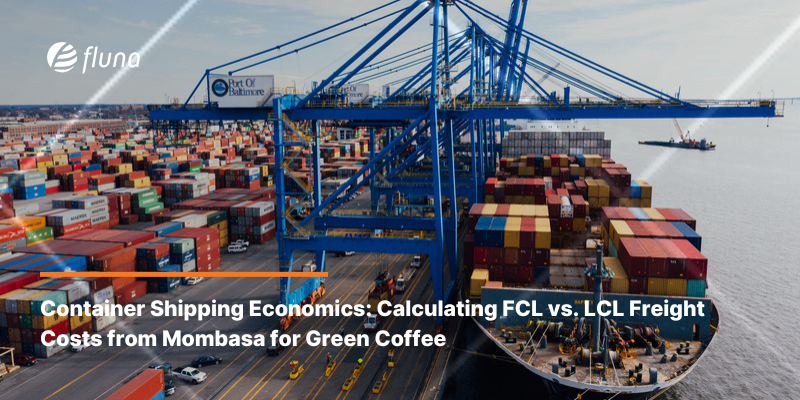
Container Shipping Economics: Calculating FCL vs. LCL Freight Costs from Mombasa for Green Coffee
By Sandra Nansbuga
Container Shipping Economics: Calculating FCL vs. LCL Freight Costs from Mombasa for Green Coffee
Calculating landed freight economics between Full Container Loads (FCL) and Less than Container Loads (LCL) is essential for roasters balancing working capital against transportation costs from East Africa. Because coffee moving from landlocked Uganda travels overland along the Northern Corridor before ocean loading, transportation pricing involves both inland trucking and marine freight. Evaluating green coffee shipping costs Mombasa allows green buyers to determine exact break-even thresholds and optimize container space utilization.
Port operations data published by the Kenya Ports Authority indicates that standard 20-foot dry containers carry between 320 and 340 60-kilogram burlap bags of green coffee, representing approximately 19.2 to 20.4 metric tons. Overland transit corridor benchmarks from the Northern Corridor Transit and Transport Coordination Authority show that flat-rate inland haulage from Kampala dry mills to Mombasa port accounts for roughly 40% to 50% of total origin logistics expense.
Line-Item Freight Comparison and Green Coffee Shipping Costs Mombasa
When shipping FCL, the fixed costs of road transport, export documentation, and Terminal Handling Charges (THC) at Kilindini Harbour are amortized across the full 19.2-metric-ton cargo mass. According to global ocean freight indices tracked by Freightos, booking a dedicated 20-foot container yields an average origin-to-destination freight cost of $0.22 to $0.32 per kilogram ($0.10 to $0.15 per pound) delivered to major Northern European ports like Hamburg, Antwerp, or Genoa.
Conversely, importing smaller micro-lot quantities (50 to 100 bags) via LCL consolidation introduces substantial logistical friction. While ocean base freight for LCL is billed per cubic meter (CBM) or revenue ton, consolidated cargo incurs mandatory Container Freight Station (CFS) devanning fees, palletization surcharges, and shared documentation costs at origin and destination. These fixed accessorial fees push the effective landed freight cost of LCL to $0.65 to $0.95 per kilogram ($0.30 to $0.43 per pound).
Beyond direct monetary expenses, LCL shipments face severe cross-contamination risks from co-loaded general freight, as well as extended transit delays of 10 to 18 additional days caused by warehouse consolidation and multi-agency customs inspections in Mombasa. These extended holding periods increase ambient moisture absorption risks, potentially compromising green bean cup clarity before ocean dispatch.
| Logistical Metric | FCL (20ft Container / 320 Bags) | LCL (Consolidated / 50-100 Bags) | Air Freight (Express / <10 Bags) |
|---|---|---|---|
| Volume / Payload Capacity | 19.2 to 20.4 Metric Tons (Full container) | 3.0 to 6.0 Metric Tons (Palletized cargo) | 0.3 to 0.6 Metric Tons (Sample/Emergency) |
| Landed Freight Cost ($/kg) | $0.22 - $0.32 / kg ($0.10 - $0.15 / lb) | $0.65 - $0.95 / kg ($0.30 - $0.43 / lb) | $3.50 - $6.00 / kg ($1.60 - $2.70 / lb) |
| Total Door-to-Door Transit | 45 to 60 Days (Direct vessel routing) | 60 to 78 Days (CFS consolidation lag) | 5 to 8 Days (Entebbe to Europe) |
| Moisture & Contamination Risk | Low (Hermetic liner seals entire load) | Moderate to High (Shared CFS handling) | Extremely Low (Rapid pressurized flight) |
| Optimal Sourcing Use Case | Core espresso blends & seasonal volumes | High-value micro-lots & trial profiles | Pre-shipment approval & auction lots |
Actionable Buyer Sourcing Checklist
1. Assess Break-Even Volume: Calculate your annualized green consumption before booking. If your sourcing requirements for a single grade exceed 150 bags (9 metric tons), shipping a dedicated FCL—even slightly under capacity—is almost always more cost-effective than paying cumulative LCL consolidation surcharges.
2. Mandate Container-Level Desiccants and Liners: When booking FCL shipments from Mombasa, contractually require high-absorption desiccants and complete GrainPro container liners. The modest $150 to $250 liner cost represents negligible insurance against condensation and sweat damage along equatorial maritime trade lanes.
3. Utilize Co-Loading Partnerships for Micro-Lots: Roasters unable to absorb a full 320-bag container should arrange cooperative container sharing with peer roasters. Consolidating multiple specialty lots from the same Ugandan exporter into a single FCL preserves favorable FCL cost structures while accommodating diverse micro-lot selections.
4. Verify Demurrage and Detention Terms: Ensure your maritime booking confirmation includes at least 14 to 21 free demurrage days at European discharge ports to accommodate potential customs document verification delays without incurring costly daily storage penalties.
FAQ
Q: How many 60kg bags of green coffee fit into a standard 20ft shipping container?
A: A standard 20-foot shipping container holds between 320 and 340 60-kilogram bags of green coffee, translating to a total cargo weight of 19.2 to 20.4 metric tons.
Q: What is the main cost driver when shipping green coffee from Uganda via Mombasa?
A: Overland trucking along the Northern Corridor from Kampala to Mombasa is the primary cost driver, frequently accounting for up to half of the total freight expense prior to ocean vessel loading.
Q: Why is LCL shipping significantly more expensive per kilogram than FCL?
A: LCL incurs disproportionately high fixed charges, including Container Freight Station devanning fees, palletization, handling surcharges, and separate customs inspections that cannot be amortized across large cargo volumes.
Sources
Northern Corridor Transit and Transport Coordination Authority