
How to compare quotes from Uganda coffee exporters: what an FOB or delivered quote should include
By Sandra Nansbuga
How to Compare Quotes from Uganda Coffee Exporters: What an FOB or Delivered Quote Should Include
Evaluating and benchmarking commercial purchase offers from origin suppliers is one of the most critical responsibilities for green coffee importers, procurement directors, and commercial roasters. Because green coffee pricing encompasses baseline commodity differentials, physical grading specifications, hermetic packaging upgrades, and multimodal logistics corridors, comparing quotes on headline price alone often leads to unexpected expenses and quality discrepancies. Understanding what constitutes an auditable Uganda green coffee FOB quote empowers buyers to evaluate exporter proposals objectively, negotiate transparent trade terms, and protect their landed margins.
Commercial Incoterms rules established by the International Chamber of Commerce define the precise allocation of shipping costs, insurance liabilities, and transfer of cargo risk between seller and buyer. When combined with export quality grading baselines from the UCDA / MAAIF and port logistics tariffs enforced by the Kenya Ports Authority, buyers can dissect every line item within an exporter's price breakdown.
Quote Structure and Uganda Green Coffee FOB Quote Components
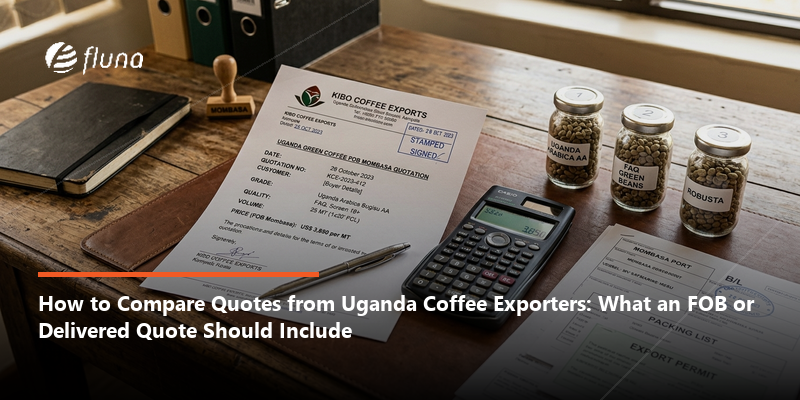
A comprehensive and transparent exporter quotation must clearly delineate five core elements: pricing structure, physical grade specifications, packaging standards, logistics scope, and payment terms. In Ugandan trade, the standard commercial baseline is Free On Board (FOB) Mombasa. An authentic FOB quote includes all inland costs required to move green coffee from Ugandan dry mills to Mombasa port—including Kampala container stuffing, Northern Corridor road or rail freight, Kenyan cross-border transit bonds, export customs clearance, and Port Terminal Handling Charges (THC)—placing the container safely on board the ocean vessel.
When comparing competing supplier quotes, buyers must verify that physical quality parameters are identical. A lower quote may conceal substandard specifications, such as a looser defect tolerance (FAQ grade with up to 5% defects rather than Clean Natural Grade 1 with under 1.5% defects) or smaller bean size retention. Furthermore, quotes should explicitly state moisture targets (strictly between 10.5% and 12.0%) and packaging types, confirming whether bags feature multi-layer GrainPro hermetic liners or single-layer jute burlap.
When evaluating delivered options—such as Cost, Insurance, and Freight (CIF) or Cost and Freight (CFR)—buyers should compare the exporter's ocean freight rate against independent freight forwarder estimates to identify any built-in logistics markups.
Requiring standardized quote templates ensures complete commercial parity across origin suppliers, streamlining procurement decision-making.
| Incoterm / Pricing Model | Cost Components Included in Base Quote | Risk & Cargo Insurance Handover | Buyer Freight Booking Responsibility | Recommended Buyer Profile |
|---|---|---|---|---|
| FOB Mombasa (Standard Origin) | Milling, packaging, transit to Mombasa, port THC | Transfers when cargo is loaded on board vessel | Buyer books ocean carrier & marine insurance | Experienced importers & trade houses |
| CIF Destination Port (Delivered Sea) | FOB Mombasa costs + ocean freight + marine insurance | Transfers on board vessel; seller buys insurance | Seller books ocean carriage to discharge port | Mid-size roasters seeking simplified ocean shipping |
| DAP Roastery Warehouse (Delivered Duty Unpaid) | All origin costs, ocean freight, destination drayage | Transfers upon container arrival at buyer facility | Seller manages complete door-to-door transit | Specialty roasters without logistics desks |
Actionable Buyer Sourcing Checklist
Demand Itemized Cost Breakdowns: Require exporters to itemize base green coffee differentials, GrainPro liner charges, and inland freight rather than providing an opaque lump-sum figure.
Standardize Physical Quality Specifications: Specify exact screen size retention (e.g. 90% over Screen 18), moisture limits (10.5%–12.0%), and maximum defect percentages in all Request for Quotations (RFQs).
Audit Included Port Charges: Confirm whether terminal handling charges (THC) and bill of lading documentation fees at Mombasa port are fully included in the seller's FOB price.
Compare Ocean Freight Benchmarks: When considering CIF quotes, obtain independent quotes from international container lines to verify that the exporter's freight markup is competitive.
Confirm Deforestation Traceability Compliance: Ensure quotes state that all necessary GPS farm polygon datasets and EUDR due diligence documentation are provided at no additional cost.
Review Payment Milestones: Structure payment terms with clear documentary triggers—such as 20% deposit with 80% payable against clean shipping documents—to balance commercial risk.
FAQ
Q: What does an FOB Mombasa quote include for Ugandan coffee?
A: An FOB Mombasa quote includes dry milling, export packaging, overland transport from Uganda to Kenya, border customs clearance, and Mombasa port terminal handling charges to place cargo on board.
Q: Why do quotes for the same Ugandan grade vary between exporters?
A: Variations often reflect differences in defect sorting standards, inclusion of hermetic GrainPro liners, inland logistics efficiency, or different terminal basis pricing spreads.
Q: Should a first-time buyer choose FOB Mombasa or CIF destination port?
A: First-time buyers without established freight forwarding relationships often prefer CIF or DAP terms to simplify ocean transit, while experienced trade desks choose FOB for freight control.
Sources: International Chamber of Commerce | UCDA / MAAIF | Kenya Ports Authority