
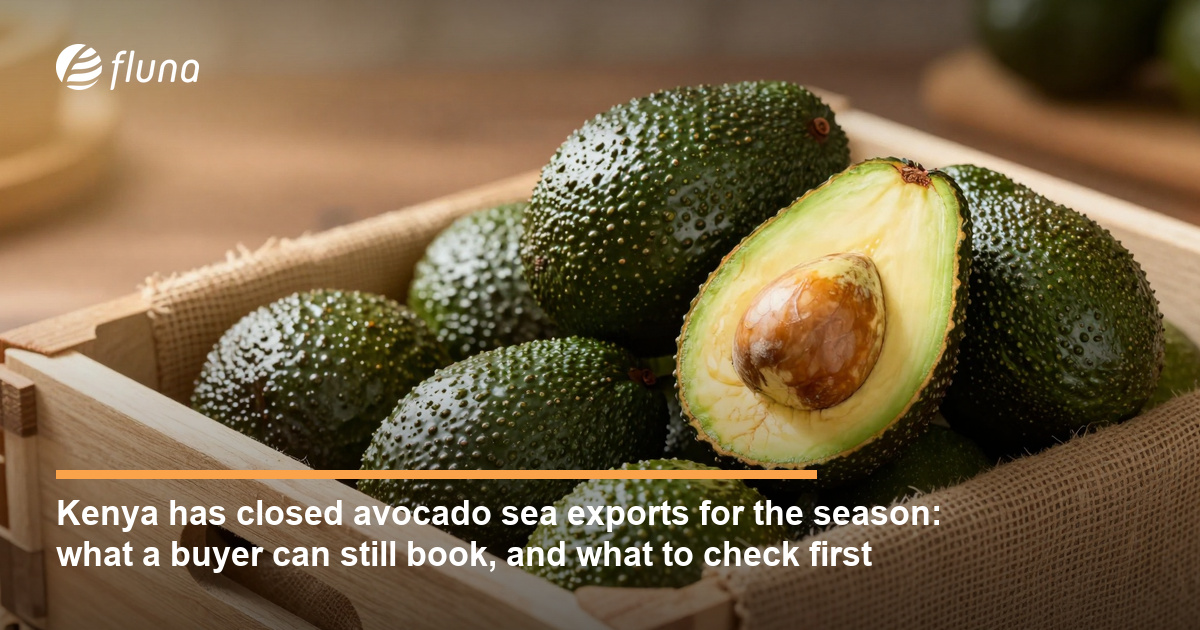
Kenya has closed avocado sea exports for the season: what a buyer can still book, and what to check first
By Sandra Nansbuga
Kenya has closed avocado sea exports for the season: what a buyer can still book, and what to check first
Kenya's Agriculture and Food Authority closed the harvesting season for sea shipment of Hass, Fuerte, Pinkerton and Jumbo avocados on 30 October 2026, after a nationwide survey found too little export-ready fruit to sustain shipments, as the The Star reported. Air shipments of the four varieties continue, provided the Horticultural Crops Directorate clears each consignment after inspection and the exporter supplies traceability details.
The closure itself is simple to describe. What decides which cargo actually moves is the clearance around it, and the authority has said that exporters and processors who breach the seasonal rules risk losing their export licences, with permits withheld from consignments that do not meet the guidelines, as People Daily reported on 5 November.
What can a buyer still book out of Kenya this season?
Air carriage is open for the four varieties, at much smaller volumes than a sea booking. Oil stocks held by processors had to be submitted for verification by 2 November, and only stocks verified in advance are being cleared for export. Imports of avocado fruit for oil processing are closed as well, which shuts the route some traders used to keep local fruit moving under cover of imported material.
Practically, a buyer holding a sea booking should expect it to be rescheduled rather than quietly loaded. Where a supplier offers sea shipment of Kenyan Hass in November, ask for the export certificate and the inspection record before paying a deposit, because a consignment that cannot clear the directorate will sit on the packhouse floor while the vessel leaves.
Why is the regulator behaving this way?
The short answer is reputation. Kenya exported 120,893 tonnes of avocados worth US$160.1 million in 2025, with the Netherlands taking US$38.8 million and the United Arab Emirates US$30.9 million, and premature harvesting had already hurt its reputation for quality. The current control is meant to stop unripe fruit leaving rather than to slow a trade that has been growing.
The pressure lands hardest on growers. Sea freight carries the large volumes, while air carriage suits smaller, higher-value consignments, so exporters working by air tend to buy less fruit, and to be pickier about what they accept and what they pay at the farm gate. Smallholders who depend on a packhouse to aggregate their crop have the least room to wait for the season to reopen.
How does the arithmetic of an air booking look?
Industry figures put air carriage for fresh produce at between US$4.50 and US$6 a kilogram, against about US$4 by sea, so a tonne that flies costs US$500 to US$2,000 more before handling. A buyer moving trial volumes can absorb that on a premium grade and cannot absorb it on a commodity lot, which is the distinction to settle before quoting a retail customer.
Ask the supplier which grade they can deliver by air this month, and ask what the traceability file will contain, since the directorate requires details for every consignment rather than a general assurance. Keep that file with the shipping documents. Where the answer is that nothing is available until the season reopens, the honest move is to book another origin rather than accept cargo whose paperwork will not survive scrutiny at destination.
What should a buyer plan for when the season reopens?
Expect the first sea cargo of the new window to be tested harder than the calendar suggests, with maturity checks and traceability files reviewed before clearance. Book volume against a named packhouse rather than a general offer, and agree in writing what happens if the inspection fails, because the risk of a rejected consignment now sits with the exporter who booked it. The reopening date is not fixed in advance.
FAQ
Q: Are all Kenyan avocado exports stopped?
A: No. Sea shipment of Hass, Fuerte, Pinkerton and Jumbo closed on 30 October 2026, while air shipments continue subject to inspection, clearance and traceability details for every consignment.
Q: Can avocado oil still leave Kenya?
A: Only from stocks that processors submitted for verification by 2 November 2026. Imports of avocado fruit for oil processing are also closed for the period.
Q: What happens to an exporter that breaches the closure?
A: The authority has warned that export licences can be revoked and permits withheld for consignments that do not meet the seasonal guidelines.
Sources: Daily Nation | People Daily