
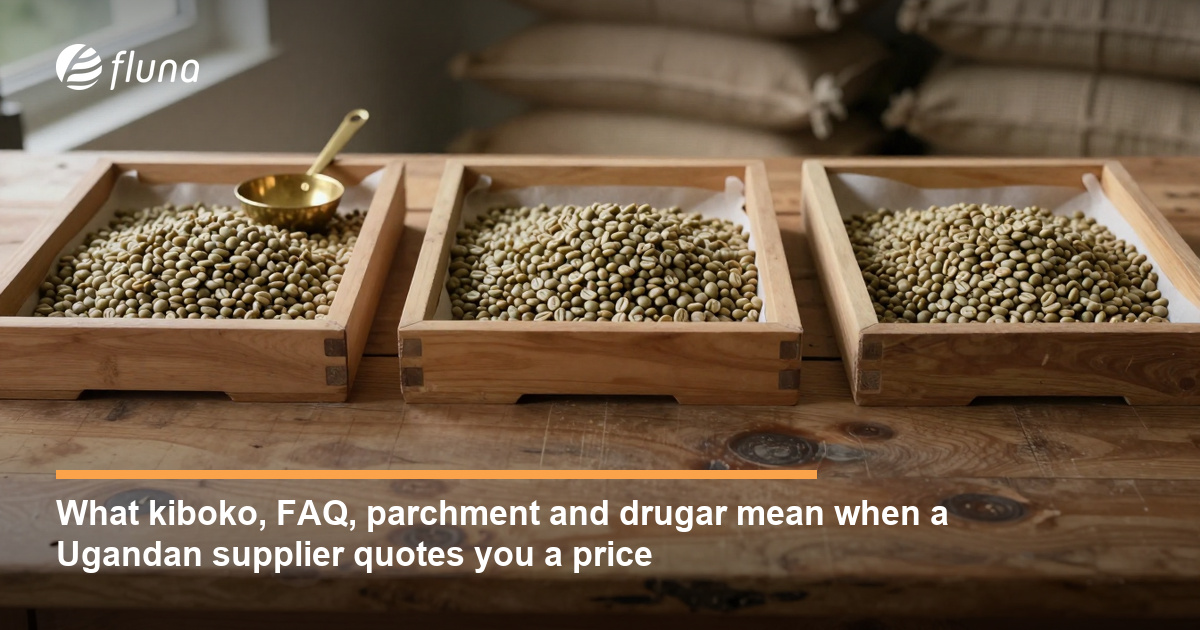
What kiboko, FAQ, parchment and drugar mean when a Ugandan supplier quotes you a price
By Sandra Nansbuga
What kiboko, FAQ, parchment and drugar mean when a Ugandan supplier quotes you a price
They are four product forms, not four grades of one coffee, and each has its own line on the UCDA daily board. A kiboko or parchment quote is a raw-material price that must be converted to clean-bean terms before you stack it against a green coffee Uganda FOB offer.
What do kiboko, FAQ, parchment and drugar mean on the Ugandan board?
On 2 November 2026 the board listed four farmgate lines in Uganda shillings per kilogram, alongside grades quoted in US cents per pound.
| Board line | What it is | Species and process |
|---|---|---|
| Kiboko, 5,000 to 6,000 | Dried cherry, husk intact | Robusta, dry processed |
| FAQ, 12,000 to 12,500 | Clean bean, Fair Average Quality | Robusta, hulled |
| Arabica parchment, 13,000 to 14,000 | Bean inside the parchment husk | Arabica, wet processed |
| Drugar clean, 14,000 to 15,000 | Clean unwashed bean | Arabica, unwashed |
Kiboko is the dried cherry with the husk still on. The Coffee Regulations, 1994 define unhulled coffee that way and allow hulling only on properly dried cherries or parchment at 13 to 14 percent moisture. FAQ means Fair Average Quality, the clean green bean left after hulling, which the UCDA Robusta Coffee Handbook describes as the product graded into screen sizes. Parchment is wet-processed arabica still inside its husk. Drugar is unwashed arabica, and the same regulations set Drugar A, B and C as its export grades.
Why the four lines are not four grades of one coffee
Two species and two routes share one block: kiboko and FAQ are dry-processed robusta, parchment is wet-processed arabica, drugar clean is unwashed arabica. A parchment quote says nothing about robusta replacement cost. Kiboko and parchment are also unhulled, while FAQ and drugar clean have already lost that weight.
How do the forms convert into the green coffee Uganda exports?
Out-turn is the clean coffee recovered from a known weight of kiboko or parchment. The handbook works an example of 540 grams of FAQ from one kilogram of kiboko, 54 percent, and sets a 50 percent minimum out-turn for dried kiboko.
At 54 percent, kiboko at 6,000 shillings becomes about 11,111 shillings per kilogram of clean coffee; at 50 percent it becomes 12,000, the bottom of the FAQ line, before hulling cost. Parchment runs the other way: the handbook gives milling losses of 20, 32 and 38 percent by parchment class and 50 percent for buni, so 13,000 to 14,000 shillings is roughly 16,250 to 17,500 at a 20 percent loss.
How do you read a farmgate quote against the grade you are shipping?
Fix the form, then the grade, then the basis. Screen 18, Screen 15 and Bugisu AA are quoted in US cents per pound, so a farmgate figure is an input cost, not the grade price. Ask which form is held, what out-turn the supplier will warrant on that lot rather than the national average, and where hulling loss is booked.
Grading is compulsory: the regulations bar export of any coffee unless graded and conforming to the export grades. A farmgate number with no form, no out-turn and no grade is not a price you can contract on.
Related reading: Uganda coffee export numbers and EU border rejection notices.
FAQ
Q: Is kiboko cheaper than FAQ?
A: Not on a clean-bean basis. On 2 November 2026 kiboko was 5,000 to 6,000 shillings per kilogram against 12,000 to 12,500 per kilogram for FAQ, but kiboko is unhulled: 6,000 converts to 12,000 per kilogram of clean coffee at the 50 percent minimum out-turn, before hulling cost.
Q: Can I compare the parchment line with the FAQ line?
A: No. Parchment is wet-processed arabica in its husk, FAQ is hulled robusta, so they differ in species, process and hulling stage. Compare each with its own grades.
Q: Which board figure matches an FOB offer for Screen 15 green coffee?
A: None of them. Screen 15 is quoted in US cents per pound and stood at 156.67 on 2 November 2026; the farmgate lines are input costs behind that figure. Convert the form to clean-bean terms first, then compare.
Sources: UCDA daily board | Coffee Regulations, 1994 | UCDA Robusta Coffee Handbook