
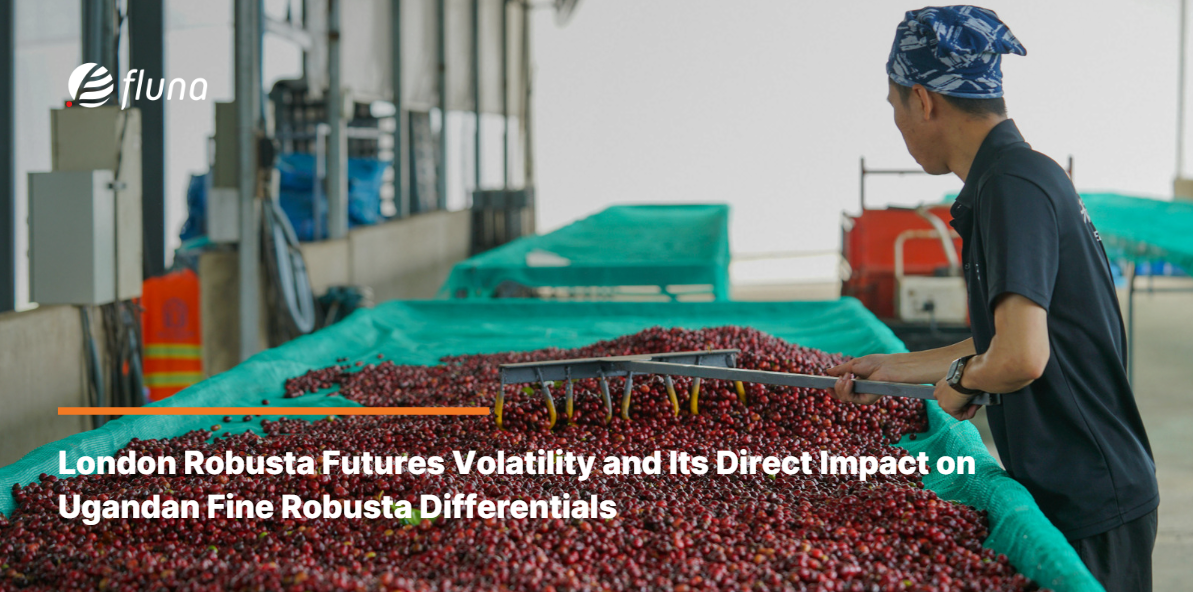
London Robusta Futures Volatility and Its Direct Impact on Ugandan Fine Robusta Differentials
By Sandra Nansbuga
London Robusta Futures Volatility and Its Direct Impact on Ugandan Fine Robusta Differentials
ICE London Robusta futures have swung across a wide range in 2026, from an eight-month low near $3,173/ton in early April to levels above $3,900/ton by July, driven by shifting Vietnamese export flows, thinning exchange inventories, and weather risk in Southeast Asia. Because Ugandan Robusta is priced as a differential to this benchmark, every leg of that swing has passed through to farmgate prices and FOB offers within weeks, not months.
What happened on the futures side
Robusta fell to an eight-month low of $3,173/ton in early April 2026 before recovering to $3,445/ton later that month, a move Reuters/Business Recorder attributed partly to diminishing seasonal supply flows from Uganda and Indonesia even as Brazil's robusta exports were reported running well ahead of the prior year. By late June, the contract had climbed to $3,639/ton, with dealers citing concern that El Niño-linked dry weather could cut into the 2026/27 crop in Vietnam and Indonesia, the world's two largest Robusta origins. Trading-day recaps through May repeatedly flagged ICE-certified Robusta stocks falling to multi-month and multi-year lows, a technical condition that tends to amplify price moves in both directions. Over the past year the contract's range has run from roughly $3,144 to $4,986/ton, according to Investing.com historical data. Separately, Vietnam's Jan–Apr 2026 coffee exports rose 15.8% year-on-year to 810,000 MT, a bearish supply signal that has periodically capped rallies.
What the Uganda data shows
Uganda's own price data tracks this closely. Per the Uganda Coffee Development Authority's May 2026 monthly report, farm-gate Kiboko (Robusta dry cherry) averaged UGX 5,250 per kilogram in May 2026, down from UGX 6,750 the previous month, while FAQ farm-gate softened to UGX 11,250 from UGX 11,750. The average export price for Robusta fell to US$3.7/kilogram from US$3.9/kilogram in April. Export volumes moved with it: Robusta shipments in May 2026 were down 24.5% in quantity and 42.6% in value against May 2025, part of a broader 21.6% quantity decline across all coffee types that month. Robusta still made up 84% of Uganda's May export volume, so the crop remains highly exposed to whatever the London contract does next.
What this means for buyers
Contract timing matters more than usual. With farmgate and FOB offers repricing within the same fortnight as ICE moves, locking volume during a low-inventory spike locks in the spike. Buyers with flexible delivery windows have more room to average into positions across the current volatility than those needing a single fixed-date shipment.
Watch the differential, not just the flat price. A rising futures floor tends to compress the premium exporters can charge for fine, low-defect lots, since sellers have less need to differentiate on price when the benchmark itself is elevated. When futures ease, that premium for verified screen size and moisture consistency tends to widen back out.
Certified-stock data is a leading indicator worth tracking. Given how closely ICE Robusta inventory levels have tracked recent price moves, procurement teams benchmarking Uganda offers may find it useful to monitor ICE certified stock reports alongside UCDA's monthly bulletins rather than relying on flat-price quotes alone.
EUDR documentation timelines don't pause for price swings. Volatility periods are exactly when traceability paperwork slips; buyers sourcing EU-bound lots should confirm origin documentation is locked in before, not during, a price spike.
FAQ
Is Uganda Robusta priced directly off the ICE London contract?
Ugandan Robusta is priced as a differential to the ICE London Robusta benchmark, so movements in the futures contract feed through to farmgate and export prices, as reflected in UCDA's monthly price bulletins.
Why did Uganda's Robusta export volumes fall in May 2026?
UCDA's May 2026 report shows Robusta export volume down 24.5% year-on-year, alongside a broader decline in the average export price to US$3.7/kilogram from US$3.9/kilogram in April; the report does not specify a single cause for the volume decline.
What is driving the current Robusta price volatility?
Reporting points to a mix of factors, including ICE certified inventory levels reaching multi-month lows, rising Vietnamese export volumes, and market concern over El Niño-linked dry weather in Vietnam and Indonesia ahead of the 2026/27 harvest.
Sources
ICE Robusta Coffee Futures contract specifications, ICE
Uganda Coffee Development Authority, Monthly Coffee Report, May 2026
London Robusta Coffee Futures Historical Data, Investing.com
Robusta coffee rallies, Business Recorder, April 22, 2026
London cocoa hits 3-week high (Robusta/El Niño item), Business Recorder, June 20, 2026
Tight ICE Inventories Lift Coffee Prices, Barchart, May 2026
Coffee Prices Rise as ICE Inventories Shrink, Barchart, May 19, 2026
Sources: Reuters/Business Recorder attributed partly to diminishing seasonal supply flows from Uganda and Indonesia | dealers citing concern that El Niño-linked dry weather could cut into the 2026/27 crop in Vietnam and Indonesia | ICE-certified Robusta stocks falling to multi-month and multi-year lows | Investing.com historical data | Vietnam's Jan–Apr 2026 coffee exports rose 15.8% year-on-year to 810,000 MT | Uganda Coffee Development Authority's May 2026 monthly report | ICE Robusta Coffee Futures contract specifications, ICE | Coffee Prices Rise as ICE Inventories Shrink, Barchart, May 19, 2026