
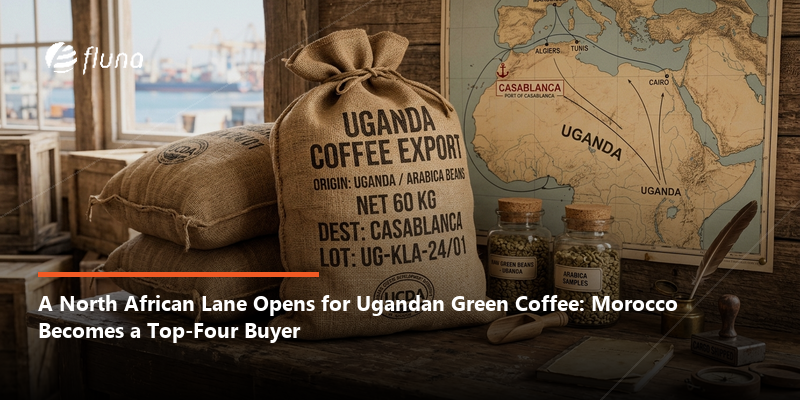
A North African lane opens for Ugandan green coffee: Morocco becomes a top-four buyer
By Sandra Nansbuga
A North African lane opens for Ugandan green coffee: Morocco becomes a top-four buyer
Morocco became Uganda's fourth-largest green coffee export destination in July 2026, taking 50,222 bags of 60 kilograms each, about 5.9 percent of that month's shipments, according to Hespress EN, reporting data from Uganda's Agriculture Ministry. The lane is almost entirely robusta, which makes it a meaningful outlet for the origin's high-volume robusta stream rather than its arabica lots. For buyers, a rising North African destination widens the buyer base against concentrated demand from Italy and Sudan.
Uganda's overall coffee exports fell in July, and Morocco's climb happened inside that decline. July shipments totaled 846,376 bags worth US$204.1 million, down 14.9 percent in volume and 18.4 percent in value from July 2025. Robustas accounted for roughly 92 percent of total export volume during the month, per the Coffee Department, MAAIF, whose monthly report the Hespress item drew on. Morocco's 50,222 bags, about 3,013 metric tons, represented 5.9 percent of exports that month, up from a 5 percent share in June, when it ranked fifth.
The Moroccan intake is essentially mono-origin robusta: 49,905 bags of robusta versus just 317 bags of arabica. That split matters. Uganda is one of Africa's largest robusta producers, and a destination absorbing nearly 50,000 bags of robusta in one month gives exporters and traders a new swing customer for the high-volume grades that underpin blend programs.
| Destination | July 2026 share | Rank | Dominant intake |
|---|---|---|---|
| Italy | 29.3% | 1 | Robusta-heavy blend demand |
| Sudan | 15.1% | 2 | Robusta |
| Germany | 10.7% | 3 | Robusta and arabica |
| Morocco | 5.9% | 4 | Robusta (49,905 of 50,222 bags) |
What this means for buyers
Origin concentration is the practical risk buyers manage, and a fourth destination at scale reduces it. July shows the top three markets still hold a combined 55.1 percent share, so any single-country slowdown, particularly in a Sudan or Italy buying cycle, would swing availability. Morocco's entry as a top-four buyer, confirmed at 5.9 percent, gives robusta buyers a benchmark for how much volume a North African lane can absorb in a single month.
The robusta-only profile of Moroccan demand is the detail traders should weight. If your program relies on Ugandan screen 15 and screen 18 robusta for espresso bases, a new nearly 50,000-bag monthly outlet competes for the same beans that European blend buyers chase. That can tighten availability for specific screen sizes and put pressure on FOB differentials when Moroccan and European orders overlap in the same shipping window.
For procurement planning, the July volume decline of 14.9 percent against a year earlier reinforces the case for forward contracting rather than relying on spot arrivals. Morocco's share rising from 5 percent in June to 5.9 percent in July points to a lane that is building, not fading. Buyers should treat it as a structural addition to Uganda's buyer base while continuing to qualify multiple sources at origin, since the same crop is now spread across more active destinations. Robustas at roughly 92 percent of monthly volume mean robusta remains the grade where this diversification pressure concentrates, so arabica buyers face less of that squeeze.
FAQ
Q: How much Ugandan coffee did Morocco buy in July 2026?
A: Morocco received 50,222 bags of 60 kilograms each, about 3,013 metric tons, equal to 5.9 percent of Uganda's coffee exports that month, according to Hespress EN citing Uganda's Agriculture Ministry data.
Q: Is Moroccan demand for Ugandan robusta or arabica?
A: It is almost entirely robusta. Of the 50,222 bags shipped to Morocco in July, 49,905 were robusta and 317 were arabica, per the July data reported by Hespress EN.
Q: Did Uganda's overall coffee exports rise that month?
A: No. July 2026 exports totaled 846,376 bags worth US$204.1 million, down 14.9 percent in volume and 18.4 percent in value from July 2025, with robusta at roughly 92 percent of volume.
Sources: Hespress EN | Coffee Department, MAAIF