
NEPC's shea processing centre in Niger State: what domestic crushing capacity does to Nigerian kernel demand
By Sandra Nansbuga
NEPC's shea processing centre in Niger State: what domestic crushing capacity does to Nigerian kernel demand
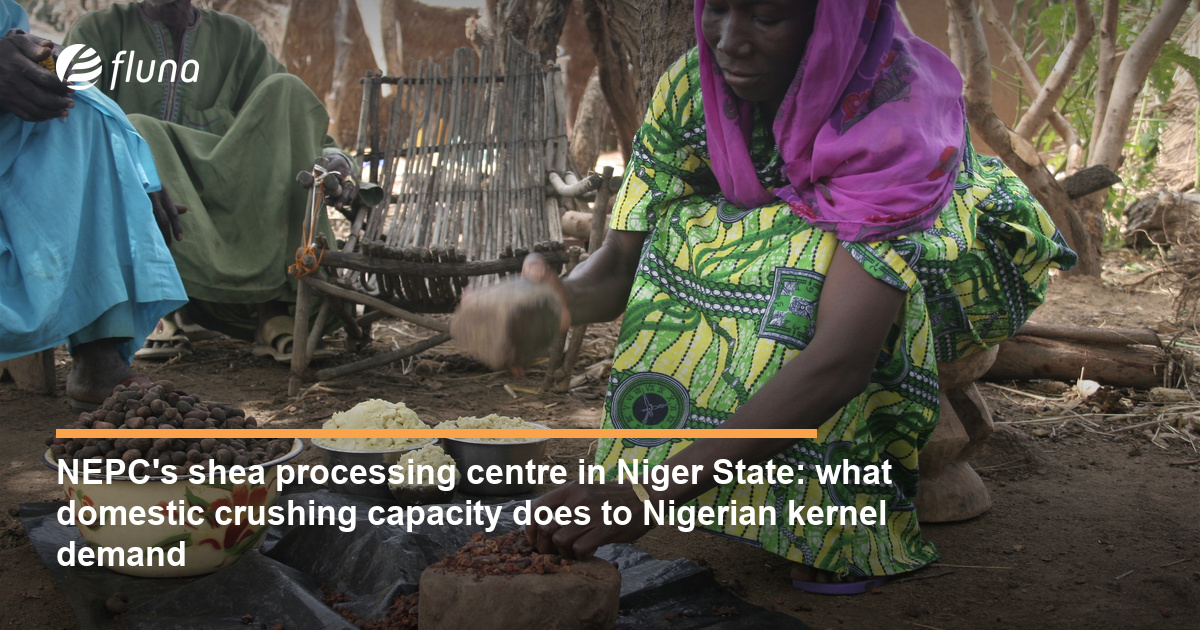
The Nigerian Export Promotion Council has opened consultations on a common facility centre for shea processing in Minna, a shared plant that would turn nuts into butter in Niger State instead of shipping kernels out. For a kernel buyer that is a second domestic bid for the same nuts, with raw shea nut exports restricted to 25 February 2027.
What has NEPC announced?
The council met shea stakeholders in Minna on the proposed centre, the News Agency of Nigeria reported on 29 October 2026. The meeting was to settle location, governance, funding and maintenance. Executive director Nonye Ayeni, represented by Samson Idowu, named high production costs, limited equipment access and weak market access as the constraints, hardest on women and small-scale processors.
Nothing is built yet. The proposal offers shared equipment for cracking, roasting, kneading, pressing and filtering. NEPC's numbers make the case: Nigeria accounts for about 40 to 50 per cent of global shea nut production, an estimated 350,000 to 400,000 tonnes a year, much of it historically leaving as raw kernels. Butter could be worth five to ten times more, NEPC said.
How much kernel would local crushing absorb?
The framework already exists. The Nigerian Commodity Exchange projects that processing 30 per cent of raw nut output, about 120,000 tonnes, would yield roughly 40,000 tonnes of butter at a 3:1 ratio, BusinessDay reported on 10 June 2026: close to a third of Nigerian nuts crushed before export.
The formal export pool is far smaller. NEPC reported 17,302.55 tonnes of shea exports in 2023, worth $14,591,419.56, Daily Trust reported on 3 May 2024. The rest moves outside it: the Presidential Food Systems Coordinating Unit estimates 90,000 tonnes of kernels leave Nigeria yearly through informal routes, Punch reported in July 2026.
| Attribute | Domestic crushing | Raw nut export via NCX | Informal kernel trade |
|---|---|---|---|
| Policy status | Promoted | Only sanctioned route | Undocumented |
| Value per tonne | Butter at 5 to 10 times nut value | Raw nut value | Raw nut value, no duty |
| Kernel for exporters | Absorbed | Released via NCX | 90,000 tonnes a year |
What sets the price a crusher can pay?
Butter parity. NEPC puts the nut-to-butter uplift at five to ten times, while the State House statement extending the ban put butter at 10 to 20 times the price of raw nuts. Either multiple lets a crusher bid above an exporter moving raw material. The catch is offtake: Ayeni tied the centre's survival to private investment and reliable purchase agreements, and capacity that cannot sell butter will not hold a kernel bid.
What this means for buyers
Price the policy before the kernel. The State House says the ban was extended in February 2026 to 25 February 2027, waivers for direct raw nut exports were withdrawn, and excess raw nuts may leave only through the NCX framework. A contract assuming open kernel shipments in March 2027 is a bet on policy: fix a review point at expiry.
Then separate crushers from traders. Ask what equipment a supplier controls and where nuts are pressed; a trader selling you kernel in April bids against a domestic crusher for the same tonne. Where the answer is butter, grade replaces fat as the specification.
Documentation travels with the operator. An EU border rejection is recorded against the consignment and the operators named in it, as Fluna's note on EU border rejection notices sets out. Confirming which checks a local body can run is the habit behind Uganda's in-country coffee certification push.
FAQ
Q: Is the Niger State shea processing centre operating yet?
A: No. NEPC is still consulting on location, governance, funding and maintenance. The offer is shared cracking, roasting, kneading, pressing and filtering equipment.
Q: Can Nigerian shea kernels still be exported?
A: Raw shea nut exports are banned to 25 February 2027, and excess raw nuts may go only through the NCX framework. Ask which route a parcel is booked under.
Q: How much kernel would domestic crushing absorb?
A: The NCX framework targets 30 per cent of raw nut output, about 120,000 tonnes, yielding roughly 40,000 tonnes of butter at 3:1, close to a third of the crop.
Sources: News Agency of Nigeria | BusinessDay | Daily Trust | Punch | State House