
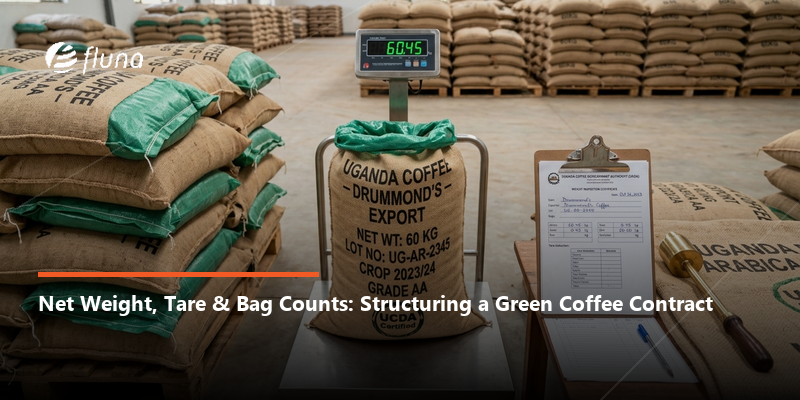
Net weight, tare and bag counts: how a Ugandan green coffee contract should state quantity
By Sandra Nansbuga
Net Weight, Tare, and Bag Counts: Stating Quantity on a Uganda Green Coffee Contract Weight Basis
In international commodity trade, the precise definition of quantity in a commercial sales agreement is just as important as the agreed FOB or CIF price. Misunderstandings regarding gross weight, tare deduction, and bag allowances can create invoice discrepancies and payment disputes between importers and origin exporters. Establishing a legally unambiguous Uganda green coffee contract weight basis ensures both parties share clear expectations regarding container stuffing volumes, moisture loss tolerances, and official weighbridge certification.
By incorporating standardized trade rules from the International Chamber of Commerce Incoterms, grading protocols from the Specialty Coffee Association, and customs documentation frameworks from the East African Community trade portal, buyers can structure watertight purchasing agreements.
Core Contract Terms: Gross Weight, Tare Deductions, and Net Quantity
A comprehensive green coffee export contract must explicitly differentiate between three distinct weight measurements:
Gross Weight: The total combined weight of the green coffee beans, the outer natural jute burlap sack, and any internal hermetic polymer liner (such as GrainPro or Ultra-Hermetic bags).
Tare Weight: The deadweight of the packaging materials deducted from the gross weight. Standard international export jute bags weigh approximately 0.90kg to 1.00kg each, while a 60kg GrainPro liner adds approximately 0.15kg. A standard contract must specify whether tare is calculated per individual sack (typically 1.0kg to 1.15kg total tare per bag) or deducted as an agreed flat percentage.
Net Weight: The actual physical mass of the green coffee beans alone. Invoicing and trade settlement must always be calculated strictly on the agreed Net Weight basis.
For containerized shipments departing Uganda, the standard commercial unit is the 60-kilogram net bag. A standard 20-foot dry ocean container accommodates exactly 320 bags, totaling 19,200 kilograms (19.2 metric tons) net weight. For specialty micro-lots, contracts may specify 30kg net bags (typically 600 to 640 bags per container or smaller consolidated pallet loads).
| Contract Specification | Standard Value / Industry Metric | Measurement Instrument & Timing | Buyer Risk & Contract Clause |
|---|---|---|---|
| Standard Bag Weight Basis | 60.0 kg Net (Specialty: 30.0 kg Net) | Calibrated industrial digital scale at dry mill | Ensures uniform palletizing and container stuffing |
| Packaging Tare Allowance | 1.00kg (Jute) + 0.15kg (GrainPro) = 1.15kg | Deducted from gross weight prior to invoicing | Prevents paying coffee bean prices for packaging tare |
| FCL Container Volume | 320 bags / 19,200 kg Net (19.2 MT) | Container weighbridge slip + stuffing tally sheet | Guarantees full payload utilization and freight efficiency |
| Transit Moisture Tolerance | Max 0.5% natural evaporation allowance | Destination bonded warehouse intake weigh-in | Protects against natural weight loss during ocean transit |
Net Shipped Weight vs. Net Landed Weight Clauses
When drafting contract quantity terms, buyers and exporters must specify the weight determination clause:
Net Shipped Weight: The invoice is settled based on the official weight certificate issued by an independent surveyor or certified export dry mill at the time of container stuffing in Uganda or loading in Mombasa. The buyer assumes the risk of minor natural moisture loss during ocean transit.
Net Landed Weight (Franchise Clause): The final invoice is adjusted based on independent weighbridge readings upon arrival at the destination discharge port. Standard contracts incorporate a franchise clause (usually 0.5%), meaning weight discrepancies below 0.5% are absorbed by the buyer, while shortfalls exceeding 0.5% are credited by the exporter.
Specifying these clauses explicitly eliminates contractual ambiguity and ensures seamless international settlements.
FAQ
Q: How many bags of Ugandan coffee fit into a standard 20-foot shipping container?
A: A standard 20ft ocean container accommodates 320 sixty-kilogram jute bags, totaling 19.2 metric tons (19,200 kg) net weight.
Q: What is the standard tare deduction for a coffee sack with a GrainPro liner?
A: The standard tare deduction is 1.15 kilograms per bag (approximately 1.0kg for the natural jute bag plus 0.15kg for the GrainPro hermetic liner).
Q: What is a typical transit weight loss tolerance for green coffee shipments?
A: Standard contracts allow a 0.5% natural moisture loss tolerance between origin shipment and destination discharge.
Sources: International Chamber of Commerce Incoterms | Specialty Coffee Association | East African Community Trade Portal