
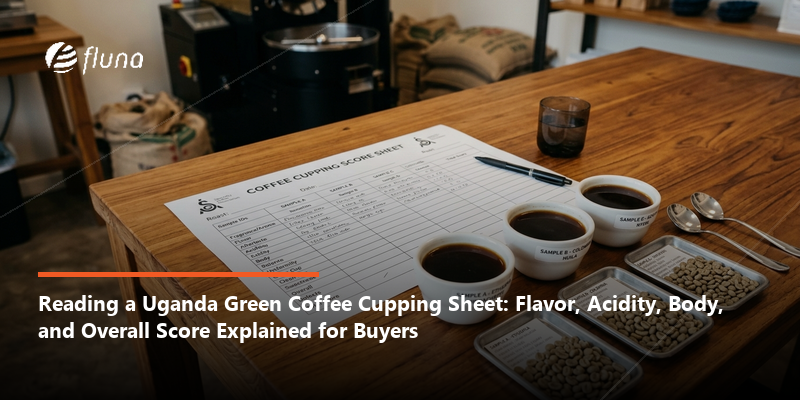
Reading a Uganda green coffee cupping sheet: flavor, acidity, body and overall score explained for buyers
By Sandra Nansbuga
Reading a Uganda Green Coffee Cupping Sheet: Flavor, Acidity, Body, and Overall Score Explained for Buyers
Evaluating sensory scorecards and laboratory cupping notes is an indispensable step for international green coffee buyers, quality control specialists, and specialty roasters seeking East African origins. Because physical grading alone cannot capture complex cup profiles, standardized sensory evaluations provide an empirical benchmark of cup cleanliness, aromatic complexity, and defect-free processing. Understanding how to interpret a Uganda green coffee cupping score empowers procurement teams to assess bean potential accurately, negotiate transparent quality differentials, and select the ideal lot for specialty espresso or filter roasting.
Standardized sensory evaluation protocols established by the Specialty Coffee Association define ten distinct sensory attributes scored on a 100-point scale. Complementary grading standards codified by the Coffee Quality Institute provide specialized scoring rubrics for both Q Arabica and Q Fine Robusta. When combined with export quality monitoring from the UCDA / MAAIF, these scorecards give buyers complete transparency into origin harvest quality.
Attribute Analysis and Uganda Green Coffee Cupping Score Interpretation
A comprehensive cupping sheet evaluates fragrance, flavor, aftertaste, acidity, body, balance, uniformity, clean cup, sweetness, and overall impression. In Ugandan Arabicas, such as Mount Elgon's washed Bugisu AA, acidity is typically characterized by vibrant phosphoric and citric notes reminiscent of blackcurrant and sweet grapefruit. Scores of 8.0 or higher in acidity and sweetness signify high-altitude cultivation above 1,600 meters, where cool maturation concentrates complex sucrose sugars within the cellular matrix.
Conversely, when evaluating Western Ugandan Fine Robusta (CWDr) lots, cupping sheets focus heavily on clean cup integrity, body density, and the complete absence of phenolic or rubbery taints. Premium Fine Robustas cultivate cupping scores between 82.0 and 85.5 points, displaying rich bittersweet dark chocolate, molasses sweetness, toasted hazelnut aromatics, and a heavy syrupy tactile mouthfeel. These characteristics make Fine Robusta an exceptional base for structured European espresso formulations.
For natural preparations from the Rwenzori region, cuppers evaluate fruit ferment cleanliness. High-scoring naturals showcase vibrant berry complexity and winey sweetness while maintaining a pristine clean cup score of 10.0 points across all five tasting bowls.
Reviewing uniform cupping scores across pre-shipment and arrival samples ensures that green lots retain their aromatic clarity throughout overland Northern Corridor transit and maritime shipping. Detailed cupping records also enable roasters to fine-tune drum airflow and development time ratios during production roasting.
| Specialty Grade | Typical Cupping Score | Acidity & Brightness Profile | Body & Crema Texture | Recommended Roaster Application |
|---|---|---|---|---|
| Bugisu AA Washed Arabica | 85.0 – 88.0 SCA Points | Vibrant phosphoric, blackcurrant, citrus | Silky, balanced, medium-plus body | Single-origin filter & light-roast cafes |
| Western Fine Robusta (CWDr) | 82.5 – 85.0 CQI Points | Low, malic, smooth cocoa-toned | Dense, syrupy, heavy espresso crema | Premium commercial & specialty espresso |
| Rwenzori Natural Arabica | 84.5 – 87.0 SCA Points | Winey, red apple, sweet stone fruit | Creamy, velvety, fruit-forward | Specialty espresso & cold brew blends |
Roaster and importer guidance
Calibrate Pre-Shipment Sample Sheets: Require exporters to provide detailed SCA cupping sheets alongside physical moisture and screen size certificates before releasing container export contracts.
Examine Uniformity and Clean Cup Scores: Ensure that all five sample bowls receive a maximum score of 2 points each (totaling 10.0), verifying that the lot is completely free from mold, over-fermentation, or phenolic defects.
Differentiate Arabica and Fine Robusta Metrics: Use CQI Fine Robusta scorecards when evaluating canephora lots, focusing on sweetness and tactile mouthfeel rather than expecting high citric acidity.
Track Score Stability Across Seasons: Maintain historical sensory logs for cooperative lots across consecutive harvests to identify high-performing washing stations and secure priority allocations.
Specify Hermetic GrainPro Protection: Protect high-scoring specialty lots (85+ points) with multi-layer hermetic liners in burlap export bags to prevent flavor fading and moisture absorption during ocean transit.
Incorporate Cupping Notes into Retail Marketing: Utilize authenticated cupping descriptors to craft compelling consumer-facing retail origin narratives that highlight Uganda's rich specialty coffee terroir.
FAQ
Q: What is considered a specialty green coffee cupping score in Uganda?
A: Coffees scoring 80.0 points or above on the SCA scale are classified as specialty. Ugandan washed Arabicas frequently score between 84.0 and 88.0 points, while altitude Fine Robustas score between 82.0 and 85.0 points.
Q: How does altitude impact cupping scores in Ugandan coffee?
A: Higher growing elevations (1,600m to 2,200m) foster slower cherry development, resulting in denser bean structures, vibrant phosphoric acidity, and higher overall cupping scores.
Q: Why are clean cup and uniformity scores crucial on a cupping sheet?
A: Clean cup and uniformity confirm that every tasting bowl is defect-free and consistent, ensuring that entire commercial export containers will roast uniformly without hidden batch taints.
Sources: Specialty Coffee Association | Coffee Quality Institute | UCDA / MAAIF