
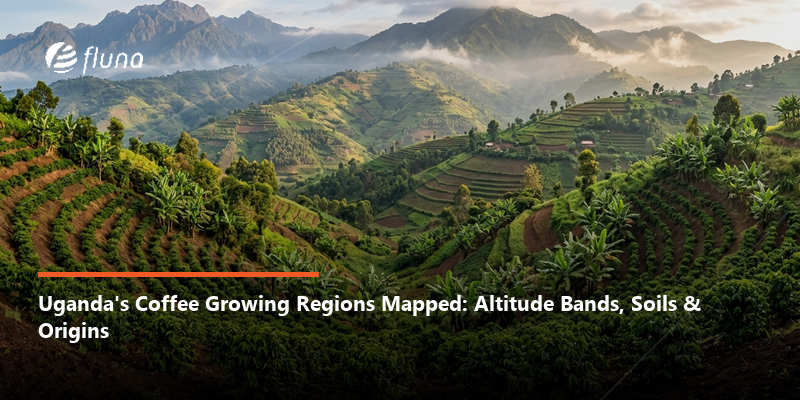
Uganda's coffee growing regions mapped: altitude bands, soils and what each area produces
By Sandra Nansbuga
Uganda's Coffee Growing Regions Mapped: Altitude Bands, Soils, and Origin Flavor Profiles
Uganda possesses one of the most ecologically diverse coffee topographies on the African continent, spanning high-altitude volcanic massifs, glacial mountain foothills, and fertile equatorial plateaus. This geographic diversity enables the country to produce world-renowned Arabica coffees alongside exceptional indigenous Fine Robustas. For green coffee buyers, navigating Uganda coffee growing regions altitude variations, soil classifications, and microclimates is essential for building a balanced seasonal sourcing portfolio.
By correlating agronomic variety databases from World Coffee Research with cupping benchmarks from the Specialty Coffee Association and harvest volume tracking from the International Coffee Organization, roasters can align specific regional origins with their precise physical screen and cup profile requirements.
Topography, Soil Profiles, and Uganda Coffee Growing Regions Altitude Bands
Uganda's coffee production is distributed across four primary geographic zones, each defined by distinct altitude bands, geological origins, and precipitation patterns:
1. Mount Elgon (Eastern Region): Rising along the Kenyan border, Mount Elgon features extinct volcanic slopes ranging from 1,500 to 2,300 meters above sea level. Rich in phosphorus-heavy volcanic andosols, this region produces Uganda's premier washed Arabicas (SL14, SL28, and KP423). The cool mountain climate slows cherry maturation, resulting in dense beans with vibrant citric and malic acidity, red berry notes, and refined black tea complexity.
2. Rwenzori Mountains (Western Region): Known as the legendary Mountains of the Moon, the Rwenzori range spans elevations between 1,400 and 2,200 meters. With fertile clay-loam soils and abundant rainfall, the region has transitioned from conventional drugar processing to specialty naturals and washed lots, characterized by complex stone fruit, dark cocoa, winey sweetness, and rich syrupy body.
3. West Nile & Zombo (Northwestern Region): Situated at 1,300 to 1,800 meters, the high plateaus of West Nile feature deep, well-drained loam soils. This emerging Arabica origin produces bright, floral cups with sweet citrus notes, gaining traction among specialty roasters seeking distinctive single-origin profiles.
4. Central & Lake Victoria Basin (Central & Southern Crescent): Spanning elevations from 1,100 to 1,300 meters, this vast equatorial plateau is the native cradle of Coffea canephora (Robusta). The deep red ferralsols and bimodal rainfall produce bold, full-bodied Robustas (Screen 18 and Screen 15) with smooth dark chocolate, cedar, and toasted nut notes that serve as foundational components for espresso blends.
| Growing Region | Primary Species & Varietals | Altitude Elevation Band | Dominant Soil Type & Climate | Characteristic Cup Profile |
|---|---|---|---|---|
| Mount Elgon (Bugisu / Kapchorwa) | Arabica (SL14, SL28, KP423, Nyasaland) | 1,500m – 2,300m | Volcanic andosols; cool alpine climate | Bright malic/citric acidity, black currant, stone fruit, cane sugar |
| Rwenzori Mountains (Kasese / Bundibugyo) | Arabica (SL14, SL28, Typica) | 1,400m – 2,200m | Glacial alluvial loam; bimodal rainfall | Dark chocolate, dried fig, winey sweetness, syrupy mouthfeel |
| West Nile & Zombo Plateau | Arabica (SL14, Catimor) | 1,300m – 1,800m | Deep loam plateau; temperate climate | Crisp citrus, jasmine florals, black tea, medium clean body |
| Central & South-Western Crescent | Robusta (Indigenous Old / Clonal CWD-r) | 1,100m – 1,350m | Fertile red ferralsols; humid tropical | Heavy body, dark chocolate, roasted hazelnut, low acidity |
Matching Regional Origins to Roasting Profiles and Sourcing Cycles
Understanding regional harvest schedules allows green coffee importers to optimize purchasing cycles. In the Eastern region (Mount Elgon), the main Arabica fly crop is harvested between August and December, reaching export vessels in early spring. Conversely, the Western Rwenzori crop experiences primary picking from September to January and a secondary fly harvest from March to June, providing roasters with year-round access to fresh green coffee.
By mapping single-origin micro-lots from specific altitude bands, specialty roasters can showcase distinct terroir narratives while commercial buyers secure high-density screen 18 Robustas for stable espresso formulations.
FAQ
Q: What is the highest coffee growing altitude in Uganda?
A: Coffee farms on Mount Elgon reach elevations up to 2,300 meters above sea level, producing high-density Arabica beans with vibrant acidity.
Q: Are Ugandan Robustas grown at high altitudes compared to other origins?
A: Yes, Ugandan Robusta grows at elevations between 1,100 and 1,350 meters, significantly higher than Vietnamese or Brazilian lowland Robusta, giving it greater bean density and sweeter cup characteristics.
Q: How do harvest seasons differ between Mount Elgon and the Rwenzori Mountains?
A: Mount Elgon's main harvest occurs between August and December, while the Rwenzori region harvests from September to January with a second fly crop from March to June.
Sources: World Coffee Research | Specialty Coffee Association | International Coffee Organization