
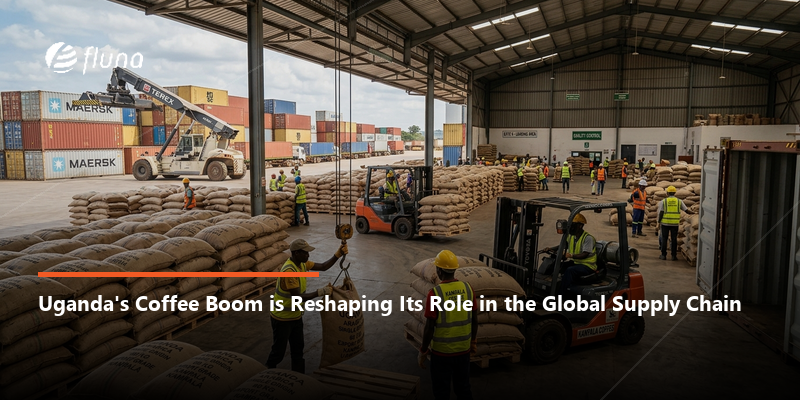
Uganda's coffee boom is reshaping its role in the global supply chain
By Sandra Nansbuga
Uganda's coffee boom is reshaping its role in the global supply chain
The International Coffee Organization has characterized Uganda's export expansion as structural rather than cyclical, with shipments on a sustained upward trajectory since mid-2023/24. That distinction matters for buyers: it signals that Uganda is becoming a durable third source of supply in a market still dominated by Brazil and Vietnam, not a temporary beneficiary of high prices. Treating the origin as a structural supplier changes how importers and roasters should plan forward contracts, diversify risk, and build sourcing relationships.
In the 12 months to April 2026, Uganda exported approximately 8.78 million 60kg bags of coffee worth US$2.38 billion, according to government figures cited by Further Africa. That was growth of about 22% in volume and 23% in value from the preceding 12-month period. The acceleration is even clearer over a longer horizon: in FY2023/24 Uganda exported 6.13 million bags worth US$1.14 billion, and less than two years later annualized shipments were approaching nine million bags with receipts more than doubled. The surge has made Uganda Africa's largest coffee exporter by volume.
The ICO's assessment is the key signal. In its December 2025 Coffee Market Report, the organization contrasted Uganda with Vietnam and Brazil, whose sharp year-on-year changes it described as a normalization rather than a structural shift. By contrast, the ICO wrote, Uganda's growth "appears structural, with exports on a sustained upward trajectory since mid-2023/24," reaching a record 7.32 million bags in 2024/25, supported by rising production, high international prices and increased stock drawdowns. The report also notes Uganda's official production target of 20 million bags by 2030.
Independent data corroborates the trajectory. Uganda Coffee Exporter reports that in FY2025/26 Uganda produced over 8 million 60kg bags and generated a record US$2.4 billion in export revenue, up from 7.6 million bags the previous year. Robusta accounts for roughly 80% of volume, with Arabica the remaining 20%, and Italy remained the leading buyer, importing over 1.8 million bags, primarily Robusta for espresso blends.
What this means for buyers
The structural-versus-cyclical distinction has practical consequences for forward supply planning. A cyclical spike invites opportunistic spot buying and short-dated contracts. A structural expansion justifies longer-term commitments, multi-year supply agreements, and investment in origin relationships, because the supply base is expected to persist and grow rather than revert.
For buyers sourcing Robusta, Uganda's position is increasingly strategic. Vietnam remains the principal Robusta powerhouse, but its production is exposed to heat and dryness, and Brazil's Robusta exports fell sharply in late 2025 as its shipments normalized. Uganda's rising production, high international prices and stock drawdowns give it a balancing role when traditional suppliers tighten. Buyers who lock in Ugandan Robusta now gain a hedge against weather-driven volatility in Vietnam and Indonesia.
There are caveats. Uganda still exports roughly 95% of its coffee as green beans, with limited domestic roasting, so the value captured at origin remains concentrated in the commodity stage. Buyers should also note the concentration of the exporter base: in November 2025 the ten largest exporters accounted for around 65% of shipments, so counterparty due diligence matters. And while the 20-million-bag target by 2030 is ambitious, the ICO's structural read suggests the direction of travel is real, not a price artifact.
For procurement teams, the practical takeaway is to treat Uganda as a core origin in Robusta planning, not a swing supplier. That means building relationships with the large licensed exporters, testing quality and traceability programs, and structuring contracts that can scale as production grows. The structural characterization from the ICO is the clearest signal yet that Uganda should be a standing line item in forward supply plans, not an opportunistic addition.
FAQ
Why does the ICO calling Uganda's growth "structural" matter for buyers? It signals the expansion is durable rather than a temporary price-driven spike. The ICO's December 2025 report contrasts Uganda's sustained upward trajectory since mid-2023/24 with Vietnam and Brazil, whose changes it called a normalization. That supports longer-term supply commitments to Uganda.
How much coffee is Uganda now exporting? In the 12 months to April 2026, Uganda exported approximately 8.78 million 60kg bags worth US$2.38 billion, per government figures cited by Further Africa. The ICO reported a record 7.32 million bags in 2024/25, and Uganda Coffee Exporter reports over 8 million bags in FY2025/26.
What should buyers watch when sourcing Ugandan Robusta? Watch the concentration of the exporter base, since the ten largest exporters handled about 65% of shipments in November 2025, and the fact that roughly 95% of coffee leaves as green beans. Both affect counterparty risk and how much processing value is captured at origin.
Sources: Further Africa | International Coffee Organization | Uganda Coffee Exporter