
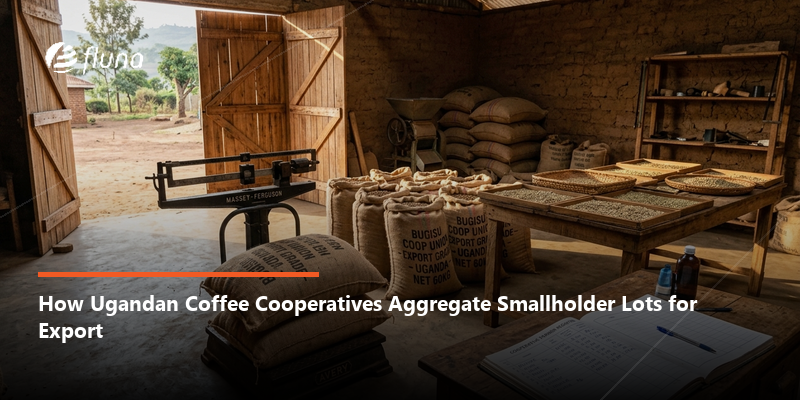
How Ugandan coffee cooperatives aggregate smallholder lots to reach export volumes
By Sandra Nansbuga
How Ugandan Coffee Cooperatives Aggregate Smallholder Lots to Reach Export Volumes
Uganda's coffee comes almost entirely from smallholder farmers, and cooperatives are the layer that turns thousands of tiny farm lots into exportable volumes. In practice, a cooperative collects parchment or dried cherry from its members, does a first level of quality sorting, bulks the coffee into commercial quantities, and passes it to a licensed exporter who grades, documents, and ships the lot. That is the Uganda coffee cooperative structure a buyer should understand before signing a contract.
Where the coffee starts: smallholder farms
Coffee is grown by about 1.8 million smallholder farmers on plots that typically range from 0.18 to 0.23 hectares, according to the UNIDO Uganda Coffee Value Chain Analysis (2025). These farms produce roughly 99 percent of Uganda's coffee. No single farm yields enough for a shipping lot, so aggregation is not optional, it is the structural backbone of the origin.
After harvest, robusta farmers dry cherries in their yards and robusta and arabica farmers often sell to middlemen; arabica parchment may be sold to middlemen or directly to cooperatives. That flow is documented in the UNIDO analysis, which maps the value chain from farm through aggregation, processing, grading, and export.
The cooperative layer: collection, grading, and bulking
Cooperatives and farmer groups give members shared access to inputs, credit, processing facilities, and market links. Yet the UNIDO analysis cautions that only an estimated 10 to 20 percent of smallholders belong to a cooperative, and most cooperatives lack the volume and capacity to process and export directly. Because of this, middlemen still buy most of the coffee, selling on to larger traders who deliver to hulling factories and then to exporters in Kampala.
For the cooperatives that do aggregate, the work is consistent: receive and weigh member lots, cup or sort for defects, bulk the coffee into contractable parcels, and hand it to a licensed exporter for final grading, documentation, and shipment. That division of roles is what separates a cooperative lot from a spot-market parcel.
Where unions and exporters fit
Above the primary cooperative sit coffee unions, which the UNIDO analysis describes as providing warehousing, quality grading, and direct market access to exporters and international buyers. The major unions include the Bugisu Cooperative Union, the National Union of Coffee Agribusinesses and Farm Enterprises (NUCAFE), the Uganda Coffee Farmers Alliance (UCFA), and the Ankole Coffee Producers Cooperative Union (ACPCU). NUCAFE reports memberships above 200,000 and ACPCU above 8,200.
Most coffee, however, still flows through middlemen and traders to roughly 132 registered coffee exporters, of which about 34 are most active. The UNIDO analysis notes the sector is concentrated, with the top 10 exporters handling a large share of shipments. For a buyer, that concentration is a reason to work with an exporter that is embedded in the cooperative network and can document each parcel it ships.
| Layer | What it collects | Grading and processing | Documentation |
|---|---|---|---|
| Smallholder farm | Cherry and dry parchment | Drying; minimal sorting | Farmer registration under the Coffee Act |
| Primary cooperative | Member lots bulked | First-level defect sorting | Member and lot records |
| Coffee union | Cooperative surpluses | Warehousing, cupping, quality grading | Traceability to members |
| Licensed exporter | Export lots | Final grading and certification | Export licenses, source records, EU market documentation |
Why documentation matters for buyers
The documentation burden has grown. The Coffee Act of 2021, highlighted on the Uganda Coffee Development Authority (UCDA) website as the national coffee act, promotes the formation of farmer organisations and cooperatives alongside mandatory registration of coffee farmers. The UNIDO analysis adds that registered exporters must keep detailed records of their coffee's source, typically for five years, which is central to meeting deforestation-free and traceability rules for markets such as the European Union.
For an importer, the practical takeaway is simple. The cooperative structure exists so smallholder lots become traceable, graded export parcels, but most coffee still reaches exporters through middlemen. When traceability and a documented supply chain matter, choose an exporter such as Fluna that sources through the cooperative layer and can show the farmer-to-lot link.
FAQ
Q: Do Ugandan coffee cooperatives export directly?
A: Very few do. The UNIDO value chain analysis notes that most cooperatives lack the aggregate volume and capacity to process and export directly, so they sell to middlemen, traders, or licensed exporters who handle final grading and shipment. The major coffee unions do hold export licenses and processing facilities.
Q: What share of Ugandan smallholders belong to cooperatives?
A: An estimated 10 to 20 percent, according to UNIDO's 2025 value chain analysis. Most coffee grown by roughly 1.8 million smallholder farmers therefore moves to exporters through middlemen and traders rather than through cooperative memberships.
Q: What documentation must a Ugandan coffee exporter provide?
A: Exporters must be licensed and keep detailed records of each coffee lot's source, typically for five years, as part of traceability rules described in the UNIDO analysis. Farmer registration is also mandatory under Uganda's Coffee Act of 2021, which underpins the link between farm lots and export parcels.
Sources: UNIDO Uganda Coffee Value Chain Analysis 2025 | USDA FAS Coffee Annual Uganda | Uganda Coffee Development Authority