
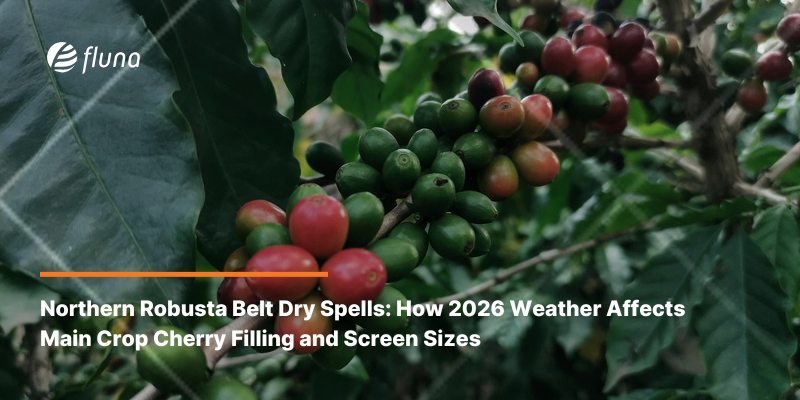
Northern Robusta Belt Dry Spells: How 2026 Weather Affects Main Crop Cherry Filling and Screen Sizes
By Sandra Nansbuga
Northern Robusta Belt Dry Spells: How 2026 Weather Affects Main Crop Cherry Filling and Screen Sizes
Extended mid-year dry spells across Uganda's northern and transitional Robusta producing zones have influenced bean size development and cherry filling rates ahead of the main crop harvest. While drought-hardy clonal varieties and agroforestry canopies have mitigated widespread moisture stress, unshaded smallholder blocks report variable Screen 18 retention. Monitoring this Uganda coffee harvest weather allows green coffee importers and commercial roasters to anticipate regional screen size distribution, adjust blend recipes, and secure premium dry mill allocations early.
According to seasonal agro-meteorological bulletins issued by the Uganda National Meteorological Authority, localized dry conditions during the critical bean expansion phase reduced soil moisture reserves across northern districts, including parts of Lango and transitional Nakasongola. In response, crop condition monitoring by the UCDA indicates that while overall national harvest volumes remain robust due to bumper yields in the southern Lake Victoria crescent, screen size profiles in drier northern zones show higher proportions of Screen 15 and Screen 12 beans.
Agronomic Impact and Uganda Coffee Harvest Weather Dynamics
Cherry filling is the critical physiological stage where the coffee plant deposits carbohydrates, proteins, and aromatic precursors into the developing endosperm. When rainfall deficits coincide with this 8- to 12-week development window, the tree prioritizes survival over bean mass, resulting in lighter bean density and smaller physical screen diameters. Farms utilizing banana intercropping and indigenous shade trees preserved soil moisture effectively, maintaining Screen 18 bean yields above 40% of total harvest turnout.
Furthermore, physiological water stress during bean expansion can accelerate cherry maturation before internal sucrose levels reach maximum concentration. To prevent cup astringency, origin mills employ precise flotation channels to remove light density floaters before mechanical hulling and polishing. Global production assessments from the International Coffee Organization highlight that localized weather anomalies increasingly drive screen size variance across major African origins.
At central dry mills in Kampala, advanced mechanical grading lines equipped with vibrating screen separators, density tables, and optical color sorters are actively isolating high-density screen fractions. This rigorous mechanical classification guarantees that export parcels meet contractual physical specifications despite regional climatic variability. For European buyers requiring consistent crema performance and uniform roasting heat transfer, sourcing from diversified regional buying networks across Central, Western, and Northern hubs ensures uninterrupted access to large-screen Clean Naturals and certified specialty micro-lots.
| Regional Production Zone | Northern Transitional Belt | Central Lake Victoria Basin | Western Highland Robusta Zone |
|---|---|---|---|
| Seasonal Moisture Conditions | Below-average rainfall with dry spells | Optimal bimodal rainfall distribution | High moisture with cool temperatures |
| Cherry Filling & Bean Density | Moderate density; faster cherry ripening | High density with uniform bean filling | Very high cellular density (high altitude) |
| Screen Size Yield Profile | Higher Screen 15 & Screen 12 share | High Screen 18 (45%+) & Screen 15 yield | Premium Screen 18 and Screen 17 yields |
| Primary Sourcing Application | Commercial soluble & value espresso | Classic European espresso blend bases | Specialty Fine Robusta single origins |
What this means for buyers
Early Contracting for Screen 18 Parcels: Because weather-induced screen variance will tighten the spot market availability of Screen 18 Clean Naturals, buyers should lock in forward physical contracts early with vertically integrated Ugandan exporters to guarantee large-screen allocations.
Blend Recipe Optimization: Commercial roasters can optimize procurement budgets by integrating Screen 15 parcels into espresso blends. High-grade Ugandan Screen 15 beans deliver identical soluble solids extraction and crema volume compared to Screen 18, often trading at advantageous origin price discounts.
Agroforestry Verification: Importers seeking climate-resilient supply chains should prioritize lots sourced from shade-grown, agroforestry-certified farmer cooperatives. These sustainable farming models preserve soil moisture during drought periods, ensuring consistent bean sizing and long-term crop stability across changing seasonal weather patterns throughout the year.
FAQ
Q: How do dry spells affect green coffee screen size distribution?
A: Moisture stress during cherry filling restricts cell expansion within the coffee bean, leading to smaller physical screen sizes (Screens 12 and 15) rather than large-screen beans (Screen 18).
Q: Does smaller screen size reduce Robusta cupping quality?
A: Not necessarily. When properly sorted to remove hollow beans or quakers, Screen 15 Ugandan Robusta exhibits the same rich body, chocolate flavor profile, and crema potential as Screen 18, making it an excellent cost-effective blending component.
Q: How are Ugandan exporters mitigating localized weather impacts?
A: Exporters utilize multi-regional sourcing across Central, Western, and Eastern zones, combined with optical color sorting and gravity separation at Kampala mills, to deliver uniform export grades that strictly meet buyer specifications.