
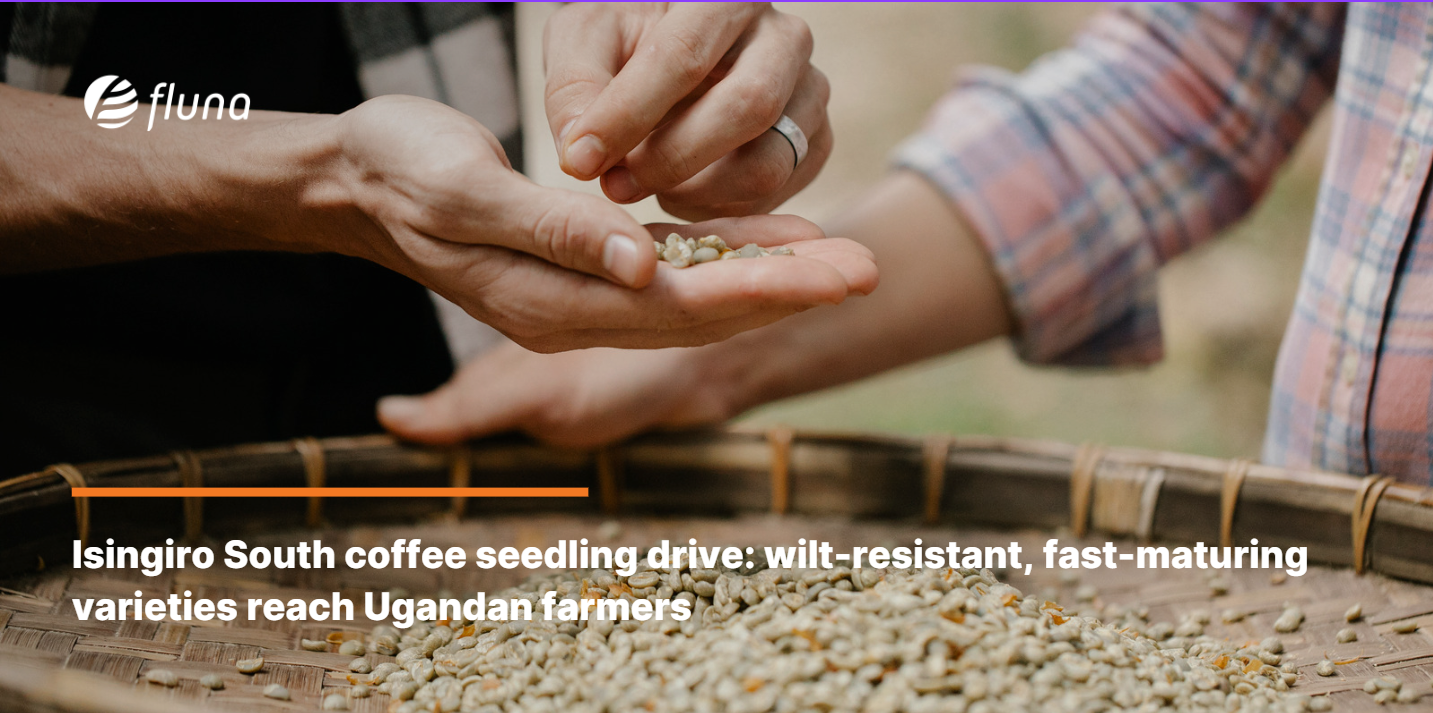
Isingiro South coffee seedling drive: wilt-resistant, fast-maturing varieties reach Ugandan farmers
By Sandra Nansbuga
Isingiro South coffee seedling drive: wilt-resistant, fast-maturing varieties reach Ugandan farmers
Uganda's Agriculture State Minister has launched a coffee seedling distribution drive in Isingiro South that promises wilt-resistant and fast-maturing varieties, but the first reports name no variety and give no seedling numbers. For buyers, the practical reading is that any added supply is a multi-year prospect and will depend on which varieties are planted and how farmers manage them.
According to Nile Post, published on 26 October 2026, State Minister Bright Rwamirama and Isingiro South MP Mujuni Maali Asensio launched the drive over the weekend. Rwamirama said the aim is to introduce coffee varieties that are wilt-resistant and fast-maturing.
What does wilt resistance change for disease pressure?
Coffee wilt disease has been a long-running drag on Ugandan output. Records from the Uganda Coffee Development Authority, cited by The Independent in October 2019, indicate that wilt disease reduced coffee exports from 4.2 million bags of green beans in 1996 to 2 million bags in 2006.
Resistant planting material attacks that loss at the tree level. The Independent reported in 2019 that the National Agricultural Research Organisation introduced three varieties, NKR8, NKR9 and NKR10, described as resistant to disease and the dry spell. Nile Post does not say whether these are being distributed.
Resistance is also not immunity to every threat. The World Coffee Research varieties catalogue lists NARO-Kituza Robusta 6 as resistant to coffee wilt disease and notes that a variety resistant to a disease today may not be resistant tomorrow.
How quickly could new supply come on stream?
Maali told farmers that if plants are looked after and planted according to guidelines, people will be harvesting in abundance within two to three years. Nile Post adds that actual yields and the time to first harvest depend on the varieties distributed, growing conditions and farm management.
World Coffee Research lists the year of first production for NARO-Kituza Robusta 6 as unknown, so there is no verified planting-to-harvest figure for that clone. The same entry notes that it must be planted together with other clones to enable fruit set, a point that matters for any block planted from seedlings of a single clone.
Volume should be kept separate from value. Early harvests from young trees would add tonnage first, while any price or premium effect depends on how those lots grade and cup.
How could bean quality be affected?
The Nile Post report says nothing about quality. The only variety-level data we could verify comes from the World Coffee Research entry for NARO-Kituza Robusta 6, which lists medium bean size (screen size 15 to 16), a 70 cupping score on the Specialty Coffee Association scale, and a weight of 19 to 22 g per 100 green beans.
That is one clone, not the drive's planting material, so quality stays an open question until the varieties are named.
What this means for buyers
First, do not price a supply increase into contracts yet. With no named varieties, no seedling count and only the MP's conditional two-to-three-year harvest estimate, the story supports a watching brief rather than volume commitments.
Second, plan on a multi-year horizon. Near-term Isingiro South volumes should be written on current-crop assumptions.
Third, ask suppliers which varieties sit in their catchment. Origin descriptions that identify the clone and planting year let a buyer separate old and new trees.
Related reading: Fluna on green coffee sample drawing and Fluna on Nigerian dried split ginger grades.
FAQ
Q: Which coffee varieties is the Isingiro South drive distributing?
A: As of the 26 October 2026 Nile Post report, none is named. Rwamirama said the aim is to introduce varieties that are wilt-resistant and fast-maturing.
Q: When will the new trees produce?
A: Maali said that harvesting in abundance should come within two to three years if guidelines are followed. Nile Post said actual timing depends on the varieties, growing conditions and farm management.
Q: Do wilt-resistant clones taste worse?
A: There is no verified general answer. The World Coffee Research catalogue lists a 70 cupping score on the Specialty Coffee Association scale for NARO-Kituza Robusta 6, a single clone.
Sources: Nile Post | The Independent | World Coffee Research varieties catalogue