
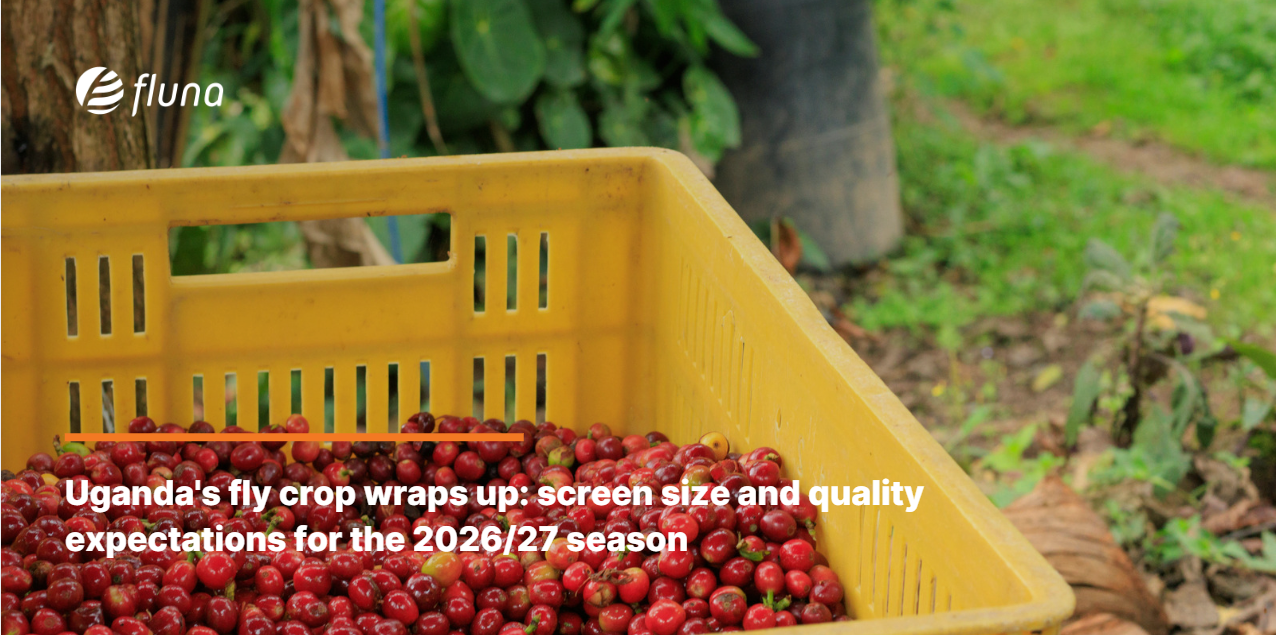
Uganda's fly crop wraps up: screen size and quality expectations for the 2026/27 season
By Sandra Nansbuga
Uganda's Fly Crop Wraps Up: Screen Size and Quality Expectations for 2026/27
Uganda's secondary fly crop harvest, which runs from April through August, has now wrapped up across the country, and the market has entered the September pre-harvest lull ahead of the 2026/27 main crop that begins in October. Buyers should expect fly crop lots to run slightly smaller on average bean size than main crop lots, and the dry, warm mid-year season that spanned this fly crop's maturation window is the key factor shaping the screen distribution and cup character of what is now shipping. The main crop, which carries the bulk of annual production, follows from October through February.
Uganda's coffee harvest calendar confirms the fly crop is the smaller of the country's two annual harvests, yielding about 20 to 30 percent of national production. It produces slightly smaller bean size on average, with more variable quality than the main crop, which accounts for roughly 70 to 80 percent of volume. August was the last fly crop month, with only Central Region Robusta and Mount Elgon Arabica still picking, and by September harvest activity is minimal across all five regions. That timing confirms the fly crop has ended and that available supply is now tightening as the market waits on new-crop arrivals.
This fly crop matured under notably dry conditions. On May 29, 2026, Uganda's Ministry of Water and Environment released its June, July, and August seasonal forecast, predicting drier and warmer than normal conditions across much of the country, with below-average rainfall driven in part by an El Niño tendency in the equatorial Pacific, as reported by Daily Monitor. Field-level reporting into early September confirms the pattern continues, with IDEA's weekly Uganda report for late August and early September 2026 noting a drier and warmer than normal start to the month. Because cherry development and final bean size respond directly to water availability during maturation, this dry, warm window is the backdrop against which fly crop screen sizes were set.
What this means for buyersScreen size is the practical place to start, because Robusta, which dominates Uganda output at roughly 80 percent of production, is graded by screen size. As the Uganda Coffee Market 2025 Commercial Overview from Buy Ugandan Coffee details, Robusta ranges from Screen 18 at the largest, through Screen 15 as the standard commercial grade, down to Screen 12 at the small end, with broken and other undergrades handled separately. The fly crop's smaller average bean size means the available screen distribution skews toward the middle and smaller grades this time of year, and the largest Robusta screens such as Screen 18 become scarce as main crop stocks deplete. Buyers under contract for large-screen Robusta should expect tighter availability until the new main crop screen profile arrives in the fourth quarter.
For Arabica, the picture differs because washed grades such as Bugisu AA, AB, and PB are assigned by region and processing rather than screen size alone. Fly crop Arabica offers fewer specialty separations, though the calendar notes that well-managed farms can still produce clean, consistent cups. The dry maturation window can support bean density, but with average screen size held down, buyers should grade fly crop lots on density and cup rather than assume main-crop screen specifications.
Pricing reinforces the timing decision. The harvest calendar indicates fly crop coffee trades at a premium to equivalent main crop grades, and September, as the pre-harvest lull, is typically the tightest supply window of the year after stocks drop and before October arrivals begin. Buyers who need volume into the fourth quarter should position before new-crop Arabica starts arriving from Mount Elgon, Rwenzori, and West Nile in October, when main crop lots with the fullest screen range and freshest cup profile become available.
Frequently Asked Questions
Has Uganda's fly crop finished?
Yes. The fly crop runs April through August, and August is the final fly crop month, with only Central Robusta and Mount Elgon Arabica still picking. By September, harvest activity drops to minimal across all five regions, per Uganda's coffee harvest calendar.
What screen sizes can I expect from the current fly crop?
Fly crop beans average slightly smaller than main crop beans, so Robusta screens skew toward Screen 15 and Screen 12, with large-bead Screen 18 scarce by mid-year. Washed Arabica grades such as Bugisu AA, AB, and PB are assigned by region and processing rather than screen size alone, so buyers should check density and cup on those lots.
How does the dry season affect quality expectations for this crop?
The Ministry of Water and Environment's June through August 2026 forecast predicted drier and warmer than normal conditions across much of Uganda, and field reporting into early September found a dry start to the month. Dry maturation can support bean density but tends to hold average screen size down, so grading fly crop lots on density and cup rather than screen size is the safer approach ahead of the October main crop onset.
Sources: Fluna Harvest Calendar | Buy Ugandan Coffee | Daily Monitor | IDEA Uganda