
Green coffee defects: how primary and secondary defects are classified and counted in Ugandan grading
By Sandra Nansbuga
Green coffee defects: how primary and secondary defects are classified and counted in Ugandan grading
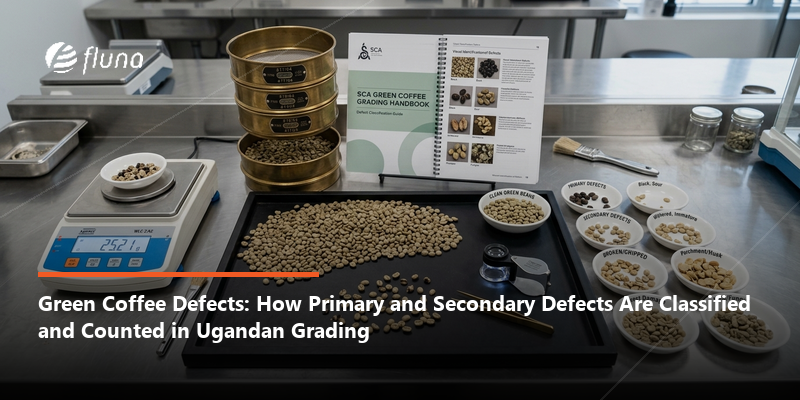
Uganda grades its exported green coffee by combining screen size with a defect count taken on a 300 gram sample, and the two systems run together: primary (Category 1) defects weigh heavily toward disqualification, while secondary (Category 2) defects are tolerated in small numbers. A Ugandan lot carries its grade only when its defect total per 300 grams falls inside the limit set for that screen size.
What is a primary or Category 1 defect?
Primary defects are the serious ones. In the classification table published by the Food and Agriculture Organization, one full black bean equals one full defect, and one full sour bean equals one full defect as well. Because a single occurrence can fail a premium lot, the standard treats each primary defect as a unit that cannot be diluted by partial counts. The FAO table lists full black, full sour and pod or cherry as defects where one bean counts as one full defect, and foreign material at larger sizes counts for more: large stones count as two full defects and medium stones count as five, with large and medium sticks counted at two and five respectively. Specialty buyers treat the presence of any primary defect as grounds to move a lot below the top grade.
What is a secondary or Category 2 defect?
Secondary defects are less severe and are counted in multiples before they add up to one full defect. Under the same FAO classification, broken or chipped beans need five pieces to equal one full defect, and shells also need five. Parchment, hull or husk, partial black and partial sour each take two to three occurrences to reach one full defect, while insect damage and water damage are weighted at two to five. Floaters count five to one. These weighting rules matter in Uganda because the export grade is judged on full defect totals, not on raw bean counts, so a handful of broken beans will not fail a lot the way one full black bean can.
How defects gate Ugandan screen grades
Uganda classifies every export lot by screen size and defect count per 300 grams under the standards administered by the Uganda Coffee Development Authority. The Uganda Coffee Guide, an independent reference for Ugandan grades sourced from UCDA and industry partners, lists the defect limits that sit beside each screen size. Bugisu AA, the premium Arabica grade at screen 18 and above, allows a maximum of 8 defects per 300 grams, while Bugisu A holds screen 17 to 18 with a limit of 12. Bugisu AB spans screens 15 to 17 with a limit of 15, Wugar permits 18 defects across the same 15 to 17 screens, and Drugar, at screens 14 to 16, allows 20. The Robusta grades follow the same logic, with Robusta Screen 18 capped at 8 defects, Screen 15 at 15 and Screen 12 at 20.
| Grade | Species | Screen size | Max defects per 300 g |
|---|---|---|---|
| Bugisu AA | Arabica | 18 and above | 8 |
| Bugisu A | Arabica | 17-18 | 12 |
| Bugisu AB | Arabica | 15-17 | 15 |
| Wugar / Drugar | Arabica | 14-17 | 18-20 |
| Robusta Screen 18 / 15 / 12 | Robusta | 18 / 15 / 12 | 8 / 15 / 20 |
Why the defect count matters before you buy Uganda green coffee
For a roaster, the defect total is the fastest predictor of cup cleanliness. A lot that passes the screen test but carries its full permitted defect limit will roast unevenly and can throw faults into the cup that no roast profile can hide. Buyers who understand the weighting of secondary defects can read a Ugandan certificate with confidence: a screen 18 Robusta with 8 permitted defects is a different commercial object from a Drugar lot allowed 20. Green coffee exporters like Fluna grade at origin precisely because defect counting shapes the contract, so clarifying the Category 1 and 2 rules is the first step in negotiating a defensible Uganda green coffee grading spec.
FAQ
Q: What is the difference between primary and secondary green coffee defects?
A: Primary, or Category 1, defects are severe problems where one occurrence equals one full defect, such as full black and full sour beans. Secondary, or Category 2, defects are milder and several occurrences, from two up to five depending on type, must combine to equal one full defect.
Q: How many defects are allowed in Ugandan green coffee grading?
A: The limit depends on the grade. Bugisu AA and Robusta Screen 18 allow a maximum of 8 defects per 300 grams, Bugisu A allows 12, Bugisu AB and Robusta Screen 15 allow 15, and Drugar and Robusta Screen 12 allow 20 per the UCDA classification reference.
Q: Is Ugandan grading based only on screen size?
A: No. Uganda combines screen size with a defect count per 300 grams, so a large-bean lot can still fail its grade if the defect total exceeds the limit for that screen size.
Sources: FAO Green Coffee Classification | Uganda Coffee Guide Grades