
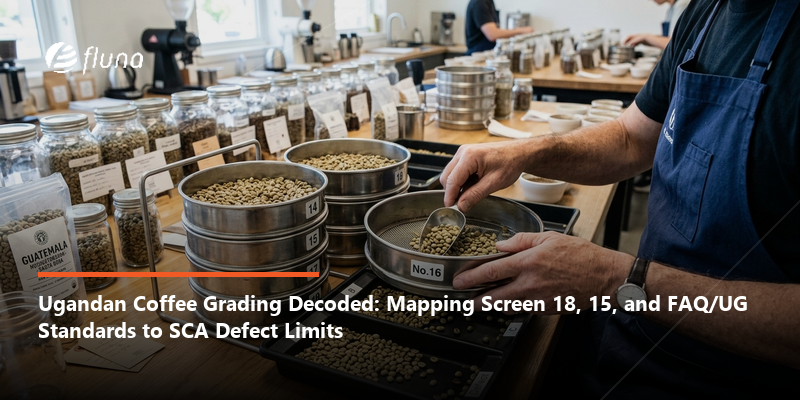
Ugandan Coffee Grading Decoded: Mapping Screen 18, 15, and FAQ/UG Standards to SCA Defect Limits
By Sandra Nansbuga
Ugandan Coffee Grading Decoded: Mapping Screen 18, 15, and FAQ/UG Standards to SCA Defect Limits
Understanding origin classification systems is essential for roasters translating national export grade designations into standardized green coffee defect tolerances and roasting profiles. In Uganda, green coffee is graded through mechanical screen sizing and physical defect counting established by statutory export codes. Decoding these Uganda green coffee grading standards allows commercial buyers and specialty roasters to map Screen 18, Screen 15, and FAQ grades directly to international Specialty Coffee Association benchmarks.
Statutory export quality regulations enforced by the UCDA define export grades using standard wire mesh sieves calibrated in 1/64th of an inch increments. Under national grading rules, Screen 18 (7.14 mm) and Screen 15 (5.95 mm) represent the primary commercial size classifications for Robusta, while Arabicas are classified into Bugisu AA (Screen 17/18), A (Screen 15/16), and PB (Peaberry). However, international buyers evaluating contracts under Specialty Coffee Association protocols require precise alignment on allowable defect counts per 350-gram sample.
Defect Thresholds and Uganda Green Coffee Grading Standards
The traditional baseline grade in Uganda's domestic supply chain is Fair Average Quality (FAQ), which represents unpolished, hulled Kiboko containing mixed screen sizes and variable defect levels up to 12% to 15%. Before export, secondary dry mills process FAQ through gravity separators, optical color sorters, and destoners to produce export-ready grades like Clean Naturals and Screen 18. This mechanical refinement removes primary defects, such as full blacks, sour beans, and pod cherry shells, which directly cause harsh bitterness and phenol taint in roasted coffee.
In addition, advanced bichromatic optical sorters eliminate immature quakers—unripened green beans deficient in sucrose that fail to caramelize during roasting and impart grassy, peanutty defects in the cup. When evaluated under Coffee Quality Institute Fine Robusta standards, Ugandan lots are categorized based on strict defect thresholds. Grade 1 (Fine Robusta) permits zero primary defects and a maximum of five secondary defects per 350 grams, alongside a strict moisture ceiling of 12.0%.
In contrast, commercial Screen 18 export lots allow up to 2% black beans and 2% broken beans, making them ideal for heavy-bodied espresso blending where high crema volume is paramount. Understanding these grading tiers enables roasters to purchase with exact clarity regarding green bean surface appearance, roast development behavior, and expected cup cleanliness.
| Grading Tier | Screen 18 Clean Natural | Screen 15 Standard Export | CQI Fine Robusta (Grade 1) |
|---|---|---|---|
| Sieve Mesh Size | Screen 18 (7.14 mm / min 90% retention) | Screen 15 (5.95 mm / min 90% retention) | Screen 16+ with uniform sizing |
| Primary Defect Limit | Max 1% to 2% (Blacks/Sours) | Max 2% to 3% (Commercial clean) | Zero primary defects allowed |
| Secondary Defect Allowance | Max 2% brokens / insect damage | Max 4% brokens / light insect | Max 5 secondary defects per 350g |
| Moisture Standard | 11.0% to 12.0% (Export stable) | 11.0% to 12.5% (Statutory max) | 10.5% to 11.8% (Tight control) |
| Roasting Application | Premium espresso crema & body base | Commercial espresso & soluble blends | Specialty single-origin canephora |
Roaster and importer guidance
Contractual Screen Tolerances: When issuing purchase orders, specify that at least 90% of the lot must be retained on the designated screen size sieve. Setting explicit screen retention minimums prevents unseparated small-bean fractions from entering premium roasting lines and causing uneven conductive roast development.
Defect Count Alignment: Importers sourcing for specialty markets should explicitly state CQI Fine Robusta standards or SCA Grade 1/2 defect limits on purchase contracts rather than generic FAQ terms. Specifying maximum allowable black and broken bean counts guarantees consistent roast coloration and uniform expansion in the roasting drum.
Sample Verification Protocols: Always conduct a physical green bean analysis on pre-shipment samples using a 350-gram test batch. Verify screen distribution, inspect for insect pinhole damage, and measure water activity before granting shipping approval.
FAQ
Q: What does FAQ mean in Ugandan coffee trading?
A: FAQ stands for Fair Average Quality, which refers to raw, unpolished green coffee hulled from dried cherries that requires secondary dry mill cleaning, destoning, and screen sorting before export.
Q: What is the physical diameter difference between Screen 18 and Screen 15?
A: Screen 18 corresponds to holes measuring 18/64ths of an inch (7.14 mm), while Screen 15 corresponds to 15/64ths of an inch (5.95 mm), representing larger, denser beans with higher thermal mass during roasting.
Q: What is the primary difference between commercial Screen 18 and CQI Fine Robusta?
A: While commercial Screen 18 allows a small tolerance for secondary defects (up to 2% brokens), CQI Fine Robusta permits zero primary defects and no more than 5 secondary defects, resulting in a cleaner, sweeter cup profile.