
What are the minimum order quantities for importing Ugandan green coffee?
By Sandra Nansbuga
What Are the Minimum Order Quantities for Importing Ugandan Green Coffee?
Structuring an efficient green coffee procurement pipeline requires commercial roasters and independent importers to understand container logistics, freight economics, and minimum purchase thresholds at origin. Because shipping from landlocked Uganda involves multimodal transport across the Northern Corridor to the Kenyan coast, order volume directly influences overland trucking tariffs, port handling charges, and ocean container rates. Navigating the exact Uganda green coffee minimum order quantity parameters empowers buyers to select the optimal fulfillment model for their roasting capacity and cash flow.
Port transit guidelines and container handling protocols published by the Kenya Ports Authority at Mombasa outline cargo consolidation rules for East African agricultural commodities. In coordination with export standards from the UCDA / MAAIF, origin exporters offer flexible shipment sizes ranging from full container loads to consolidated pallet consignments and air-freight specialty micro-lots.
Container Sizing and Uganda Green Coffee Minimum Order Quantity Options
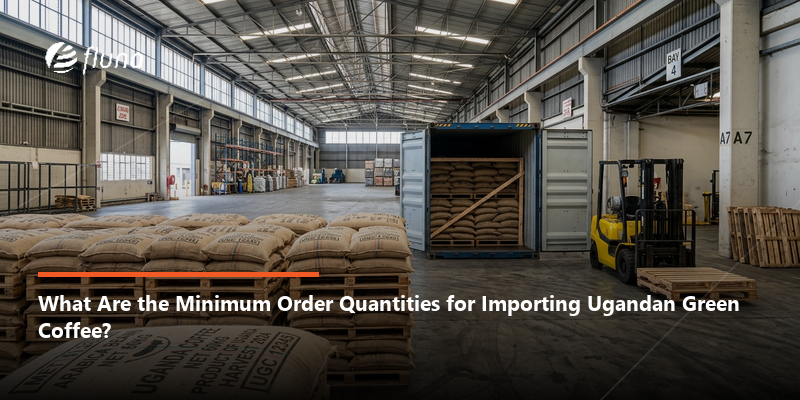
The standard commercial benchmark for international green coffee trade is the Full Container Load (FCL). A standard 20-foot ocean shipping container accommodates approximately 320 burlap bags (60kg net weight each), totaling 19.2 metric tonnes (19,200 kg) of green coffee. Sourcing full container loads offers the lowest possible freight cost per kilogram, as inland rail or road tariffs from Kampala to Mombasa and ocean freight rates are amortized over maximum payload capacity.
For independent specialty roasters and regional micro-roasteries requiring smaller volumes, integrated exporters provide Less-than-Container Load (LCL) consolidation services. Under LCL arrangements, the minimum order quantity typically ranges from 10 to 50 bags (600kg to 3,000kg) packed on secure export pallets. Consolidated cargo is stuffed into shared ocean containers at Mombasa freight stations. While LCL incurs slightly higher per-kilogram consolidation and destination de-vanning fees, it enables roasters to diversify origin offerings without committing to full container capital outlays.
Finally, for rare auction micro-lots, experimental anaerobic preparations, or urgent pre-shipment cupping lots evaluated under Specialty Coffee Association protocols, air-freight shipping allows orders as small as 1 to 5 bags (60kg to 300kg) dispatched directly from Entebbe International Airport.
Working with professional freight forwarders experienced in East African export logistics ensures that even small palletized consignments clear Mombasa customs and arrive at European discharge ports with verified phytosanitary integrity.
| Fulfillment Model | Minimum Order Volume (MOQ) | Transit Lead Time | Relative Freight Cost | Packaging Specification |
|---|---|---|---|---|
| Full Container Load (FCL 20ft) | 320 Bags / 19.2 Metric Tonnes | 35 – 50 Days (Ocean transit) | Lowest ($0.12 – $0.22 / kg) | 60kg Jute + GrainPro Liner |
| Less-than-Container Load (LCL) | 10 – 50 Bags (0.6 – 3.0 MT) | 45 – 60 Days (Consolidated) | Moderate ($0.35 – $0.65 / kg) | Palletized Burlap + Hermetic Wrap |
| Air Freight Express Micro-Lot | 1 – 5 Bags (60kg – 300kg) | 5 – 10 Days (Entebbe direct) | Highest ($3.50 – $6.00 / kg) | Double-wall Hermetic Export Boxes |
Actionable Buyer Sourcing Checklist
Align Order Size with Roasting Demand: Calculate your quarterly green coffee consumption to determine whether a full 19.2 MT container or palletized LCL shipments offer the best balance of working capital and freight efficiency.
Inquire About Multi-Grade Split Containers: Many integrated Ugandan exporters permit split-container loadings (for example, 200 bags of Screen 18 Robusta combined with 120 bags of Bugisu AA Arabica in a single 20ft box), maximizing product variety within standard FCL freight rates.
Require Hermetic GrainPro Protection: For all order sizes, ensure that contract terms specify GrainPro or multi-layer hermetic liners inside burlap sacks to protect green beans from humidity fluctuations during maritime transit.
Confirm Inland Transit Documentation: Verify that your exporter provides complete bonded transit documentation, including the COMESA transit manifest and Phytosanitary certificates, to prevent customs delays between Kampala and Mombasa.
Plan Adequate Buffer Lead Times: Account for multi-stage transit schedules by adding a 2- to 3-week logistics buffer to prevent roasting production interruptions during seasonal shipping bottlenecks.
FAQ
Q: What is the minimum quantity of Ugandan coffee required for a full container?
A: A standard 20-foot shipping container holds 320 export bags of 60kg each, totaling 19.2 metric tonnes (19,200 kg) of green coffee.
Q: Can smaller coffee roasters purchase less than a full container?
A: Yes. Exporters offer LCL palletized shipments with minimum order quantities as low as 10 to 50 bags (600kg to 3,000kg), as well as split-container loadings that combine multiple grades into one box.
Q: What is the fastest shipping method for sample lots and specialty micro-lots?
A: Air freight from Entebbe International Airport allows delivery of 1 to 5 bags within 5 to 10 days, ideal for urgent harvest samples, roasting competitions, and exclusive micro-lots.
Sources: Kenya Ports Authority | UCDA / MAAIF | Specialty Coffee Association