
Uganda risks losing buyers over inconsistent coffee quality, Kabushenga warns: the quality message for exporters
By Sandra Nansbuga
Uganda Risks Losing Buyers Over Inconsistent Quality: Why Strict Green Coffee Grading Matters
Origin quality consistency and rigorous pre-shipment compliance have emerged as decisive commercial factors for roasters and green coffee importers sourcing from East Africa. In recent industry briefings, veteran coffee leader Robert Kabushenga issued a stark warning that Ugandan exporters risk alienating international buyers if post-harvest handling and green coffee grading standards are compromised during high-volume export cycles. When volatile market prices incentivize rapid aggregation over disciplined grading, shipment quality fluctuates, undermining buyer confidence in Uganda's origin reputation.
The warning highlighted by Ugandan trade reports and Daily Monitor reflects a growing consensus among regulatory authorities, including the UCDA / MAAIF and international market bodies such as the Specialty Coffee Association. For commercial and specialty buyers alike, establishing clear physical thresholds at origin is essential to preventing downstream manufacturing disruptions and container rejections.
Export Discipline and Standardized Green Coffee Grading at Origin
Uganda's coffee sector has achieved record export volumes across both Robusta and Arabica growing zones. However, rapid volume expansion creates operational bottlenecks across rural buying networks. When competition among local aggregators intensifies, unvetted intermediaries frequently blend mixed-maturity lots, deliver improperly dried FAQ parchment, or cut corners on secondary gravity separation. This lack of upstream discipline introduces secondary defects—such as black beans, sour seeds, and insect damage—that directly degrade cup score and roast uniformity.
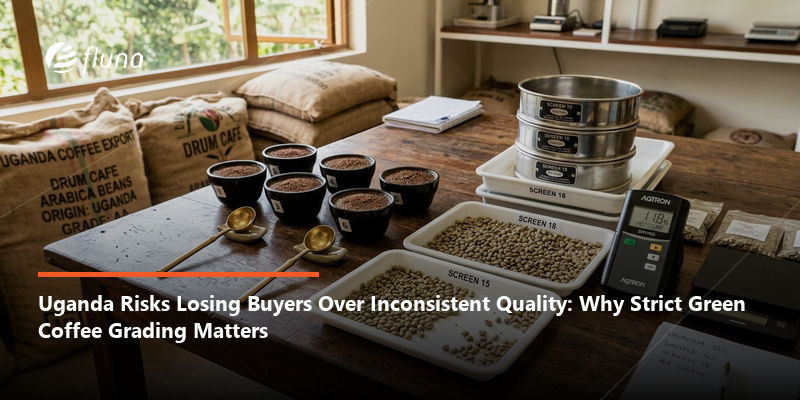
To preserve long-term origin value, international buyers must hold exporters accountable to national Uganda Standard specifications (US 44 for Robusta and US 45 for Arabica). Standardized screen separation (Screen 18, 17, 15, and 12 for Robusta; Bugisu AA, A, and PB for Arabica) ensures that green beans roast at predictable thermodynamic rates. Furthermore, strict moisture controls prevent microbial degradation during maritime transit through Mombasa or Dar es Salaam.
When exporters maintain rigorous laboratory grading protocols, roasters receive uniform green lots that perform consistently in high-speed commercial roasting and specialty espresso blending. Conversely, failing to enforce standardized defect caps forces buyers to source alternative origins that guarantee predictable physical deliveries.
| Grading Parameter | Standard Export Specification | Direct Impact of Quality Shortcuts | Buyer Sourcing Risk | Origin Verification Action |
|---|---|---|---|---|
| Screen Size Uniformity | ≥90% retention on target screen (e.g., Screen 18) | Mixed bean sizing; uneven roast color and scorching | Inconsistent extraction yields and customer churn | Mandate calibrated mechanical screen sieve audits |
| Defect Count Tolerances | ≤1.5% primary defects; ≤3.0% total defects | Quakers, black beans, sour beans entering roast batches | Harsh astringency, phenol notes, and flattened cup profiles | Require pre-shipment sample defect counts per 300g |
| Moisture Content | 11.0% to 12.5% maximum moisture | Excess water activity (>0.60 aw); accelerated aging | Ochratoxin A mold risk and bag condensation in transit | Demand digital moisture meter readouts at container stuffing |
| Foreign Matter & Stones | 0.0% foreign matter (Zero tolerance) | Pebbles, husks, and metal fragments bypassing destoners | Severe mechanical damage to industrial roasting equipment | Verify optical color sorter and destoner dry mill passes |
What this means for buyers
Contract Unambiguous Physical Specifications: Explicitly state screen retention minimums, maximum defect counts per 300g, and maximum moisture limits in purchase contracts rather than relying on generic trade grades.
Require Pre-Shipment Inspection Certificates: Mandate official UCDA quality inspection certificates and independent third-party surveyor grading reports before releasing balance payments or issuing letters of credit.
Audit Exporter Dry Mill Infrastructure: Partner with established exporters that utilize modern multi-channel optical sorters, gravity tables, and calibrated mechanical screens to guarantee physical lot uniformity.
Establish Hermetic Packaging Standards: Require high-grade Arabica and specialty Robusta lots to be packed in multi-layer hermetic liners (GrainPro or Ecotact) inside food-grade jute sacks to lock in moisture stability during equatorial transit.
Implement Pre-Shipment Sample Approval Protocols: Validate that production roast profiles and laboratory moisture readings match approved PSS lots prior to container vessel loading at East African ports.
Reward Exporters with Long-Term Contracts: Incentivize origin partners who maintain strict quality controls by offering multi-container forward contracts and reliable off-take commitments.
Track Origin Sourcing Chains: Work exclusively with exporters who operate direct smallholder washing stations and documented primary processing infrastructure to prevent untracked spot market lot contamination.
FAQ
Q: Why are Ugandan coffee leaders warning about quality inconsistency?
A: Rapid export growth and high commodity prices have caused some aggregators to rush drying and bypass optical sorting, leading to variable lot quality that threatens buyer trust.
Q: What are the primary export screen sizes for Ugandan Robusta?
A: Ugandan Robusta is commercially graded by bean size into Screen 18 (large bold beans), Screen 17, Screen 15 (standard commercial), and Screen 12.
Q: How can roasters ensure their Ugandan coffee meets contract standards?
A: Roasters should specify defect limits per 300 grams, enforce moisture thresholds of 11.0% to 12.5%, and require pre-shipment sample approvals before container loading.
Sources: Daily Monitor / Independent Uganda | UCDA / MAAIF | Specialty Coffee Association