
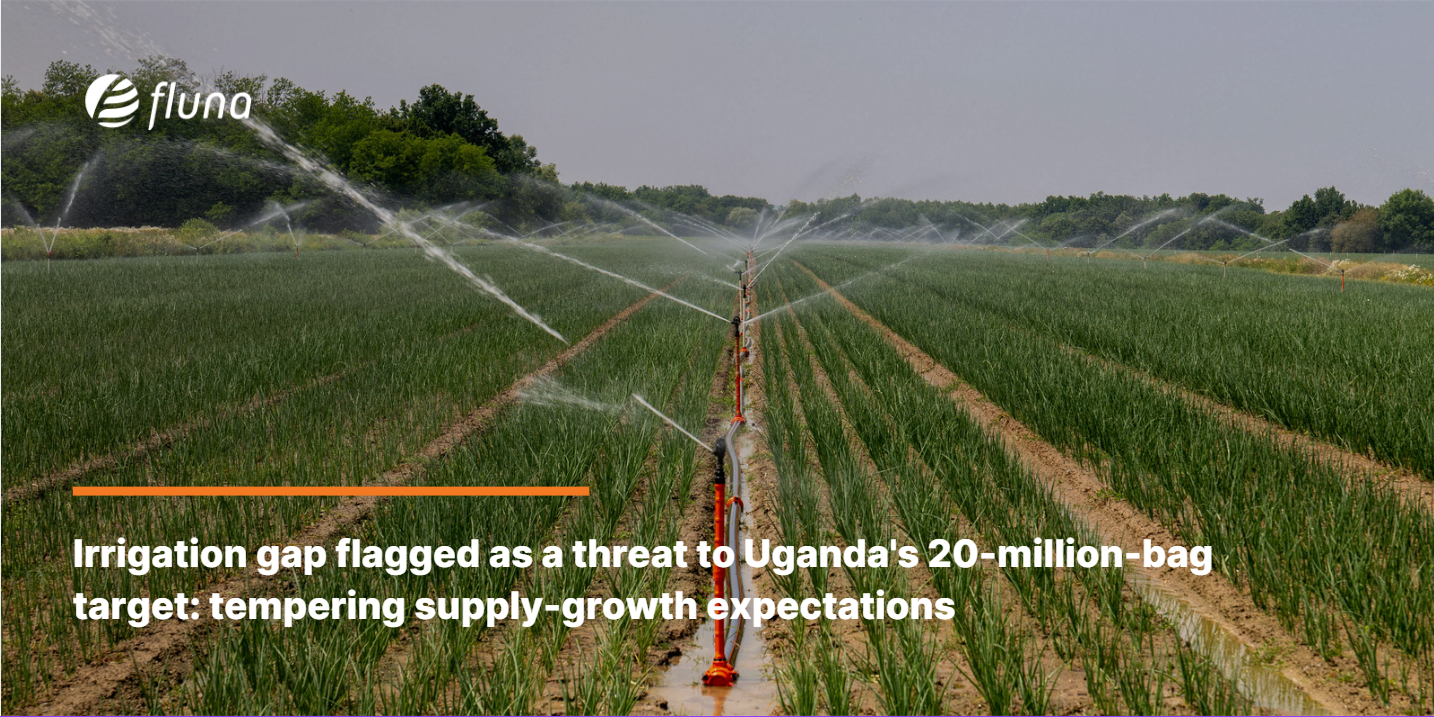
Irrigation gap flagged as a threat to Uganda's 20-million-bag target: tempering supply-growth expectations
By Sandra Nansbuga
Irrigation gap flagged as a threat to Uganda's 20-million-bag target: tempering supply-growth expectations
Uganda's ambition to reach 20 million bags of annual coffee production by 2030 hinges on expanding irrigation and farm technology, according to Volcafe's regional general manager for Uganda and Ethiopia, and the current irrigation gap is a real constraint on how fast exportable supply can actually grow. Dry weather has already caused significant crop losses in parts of Greater Masaka, exposing how vulnerable Uganda's production is to rainfall-driven conditions. For buyers of Ugandan green coffee, the takeaway is that near-term supply growth is likely to be more gradual than the headline national target suggests, which matters for how procurement teams price forward contracts and where they set volume expectations.
The warning came from Jeremy Mpalampa, Volcafe's Regional General Manager for Uganda and Ethiopia, speaking at the 2026 Uganda and Rwanda Trade and Investment Roadshow in Kampala, as reported by ChimpReports. Mpalampa argued that investment in irrigation technology and climate-resilient material technologies could help stabilize production, and pointed to solar-powered irrigation as a way to keep farms producing through dry spells. He said the financing would need to come from the private sector, banks, development partners and government together.
The 20-million-bag target is not new. It dates to the Uganda Coffee Roadmap adopted in 2017, which set a goal of raising production to 20 million bags and exports to between USD 1.5 billion and 2.2 billion per year by 2030, according to World Coffee Research. Mpalampa said Uganda's coffee exports have grown from around 3 million bags in the early 2010s to about 8 million bags, putting the country on a trajectory toward the target. He also cited Uganda's fundamentals, including suitable land and climate, the ability to produce both arabica and robusta, and what he described as some of the world's lowest coffee production costs.
The same remarks carried a qualification that traders should hear. Mpalampa stressed that raising production alone would not be enough, and that Uganda also needs to improve quality and reduce post-harvest losses, saying a lot of value is lost after harvest before coffee reaches market. He identified quality planting material and financing for fertilizer, irrigation and productivity-enhancing technologies as key requirements, and flagged investment in nurseries, mother gardens and seedling multiplication as necessary to meet farmer demand.
What this means for buyers
The practical reading for a coffee importer or roaster sourcing Ugandan green coffee is that the 2030 target functions as a long-term ambition, not a near-term supply promise. Because production is heavily rain-fed and the irrigation gap is acknowledged even by a major trading house with on-the-ground Uganda operations, buyers should expect gradual year-on-year gains rather than a step change in exportable volume in the coming seasons.
For forward contracting, that argues for building weather risk into volume commitments. A contract that assumes steady supply growth from Uganda could leave a buyer short if dry spells in arabica-growing areas repeat the Masaka experience. Locking in firm volumes for nearer terms, and keeping buffer or alternative-origin supply available for later positions, is the more conservative approach while irrigation coverage stays limited.
Quality consistency is the other lever. Since post-harvest losses and quality improvement rank alongside production growth as stated priorities, a Ugandan supplier that invests in processing, grading and stable screen-size outturns protects consistency even in a season where rainfall varies. For procurement managers, that means supplier selection on the basis of processing depth and traceability, not just volume capability, becomes a more meaningful hedge within an overall Uganda coffee export program.
None of this changes Uganda's structural appeal, which includes both arabica and robusta production and a cost base that is favorable on a global scale. It simply tempers the pace at which that potential converts into tradeable volume.
FAQ
Q: What did Volcafe warn about Uganda's 20-million-bag coffee target?
A: Volcafe's regional general manager for Uganda and Ethiopia, Jeremy Mpalampa, said Uganda's ambition to reach 20 million bags of annual production by 2030 depends on expanding irrigation and farm technology, citing dry-weather crop losses in parts of Greater Masaka as evidence of production vulnerability.
Q: When and where were the remarks made?
A: Mpalampa spoke at the 2026 Uganda and Rwanda Trade and Investment Roadshow in Kampala, and the remarks were reported by ChimpReports on September 18, 2026.
Q: Why should an irrigation gap matter to green coffee buyers?
A: Because Uganda's coffee is largely rain-fed, limited irrigation coverage means exportable supply growth is likely to be gradual rather than a step change, which buyers should factor into forward-contract volumes and quality-consistency planning rather than relying on the 2030 national production target.
Sources: ChimpReports | World Coffee Research