
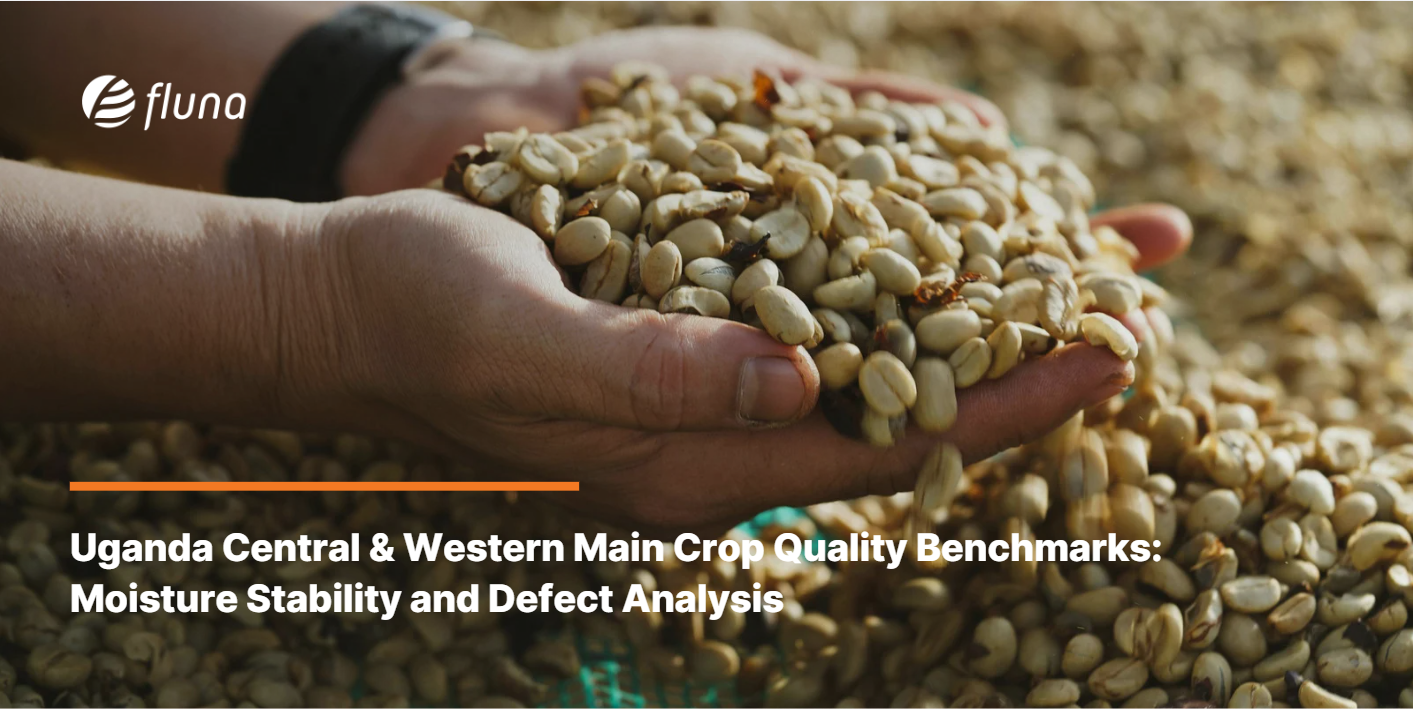
Uganda Central & Western Main Crop Quality Benchmarks: Moisture Stability and Defect Analysis
By Sandra Nansbuga
Uganda Central & Western Main Crop Quality Benchmarks: Moisture Stability and Defect Analysis
Uganda's public coffee reporting tracks harvest timing and export volumes by region, but it does not publish moisture content, bean density, or physical defect counts as separate benchmarks for Central versus Western growing zones; those thresholds are set nationally by grade and screen size, applying the same way regardless of where a lot was grown. What is verifiable for the current season is that the main crop in Greater Masaka (Central) and the South Western region was reported winding down as of UCDA's June 2026 report, against a backdrop of record annual export performance concentrated in exactly those two zones.
Export performance tied to these regions. Uganda's coffee export earnings reached $2.3 billion over the 12 months to May 2026, up 16% in volume and 11% in value year-on-year, with total exports of 8.6 million 60-kilogram bags, according to the Ministry of Agriculture, Animal Industry and Fisheries Coffee Department. May 2026 alone saw 617,491 bags exported worth $151.7 million, a decline compared with May 2025 attributed to seasonal factors. Ministry reporting has previously attributed strong export volumes specifically to good main-crop harvests in Masaka and the South Western region, according to ChimpReports' coverage of an earlier Ministry report, underscoring how central these two zones are to Uganda's overall export performance.
Harvest timing. UCDA's Monthly Coffee Report for June 2026 noted that the main harvest season in Greater Masaka and the South Western region was winding down, with July 2026 exports projected at 800,000 bags. This places both regions at the tail end of the 2025/26 main crop cycle as of that report.
Regional production shares. USDA's Foreign Agricultural Service reports that the South Western Region, growing both Robusta and Arabica, accounts for nearly half of Uganda's total coffee output, while Greater Masaka and the Central Region, Robusta-dominated, each contribute about 15% to total output, according to the USDA Foreign Agricultural Service's Coffee: World Markets and Trade report.
What determines quality: grade, not geography. Uganda's moisture and defect standards are set out in the Uganda National Bureau of Standards' draft specification DUS 1957, which defines thresholds by grade and screen size uniformly, regardless of growing region. UCDA's own description of secondary processing confirms coffee is dried if moisture content exceeds 13% at hulling, and that gravimetric sorting, which separates beans by density, is a standard step in export grading, applied at the grading factory rather than tied to a specific growing zone. UCDA further states that of roughly 19 active export grading factories, four are in the Bugisu region (East), one is in Mbarara (Western), and the remainder are in Kampala (Central), meaning most physical grading and density sorting happens in and around Kampala regardless of where the coffee itself was grown.
What this means for buyers
| Attribute | Central Region (incl. Greater Masaka) | South Western / Western Region |
|---|---|---|
| Share of national output | About 15% (per USDA) | Nearly half of total output (per USDA) |
| Dominant coffee type | Robusta-dominated | Both Robusta and Arabica |
| Main crop status (June 2026 UCDA report) | Winding down | Winding down |
| Export grading factory presence | Majority (Kampala area) | One confirmed factory (Mbarara) |
Since moisture and defect thresholds are applied at the grading-factory level under a single national standard, "Central" or "Western" origin alone is not a reliable proxy for a specific moisture percentage or defect count; the applicable specification is determined by grade and screen size, not by which region grew the cherry. What does vary meaningfully by region is timing and physical handling: with both Central and South Western main-crop harvests reported as winding down in June 2026, coffee moving to market now will largely pass through Kampala-based grading factories regardless of origin, since only one confirmed export grading facility operates in the Western region itself. Buyers sourcing Western-origin lots specifically should confirm which facility performed secondary processing and request the certificate of analysis tied to that specific lot, since time between farm and grading factory, not growing region, is the more relevant variable for consistency. Given that Uganda's overall export volumes and values have been running well above the prior year, buyers should also expect continued competition for main-crop lots from these two zones as the harvest concludes and volumes taper into the fly crop period.
FAQ
Q: Does UCDA publish separate moisture or defect data for Central versus Western Uganda coffee?
A: No. UCDA's national grading standards set moisture and defect thresholds by grade and screen size, not by growing region. Regional reporting from UCDA and the Ministry of Agriculture covers export volumes, prices, and harvest timing, not region-specific physical quality metrics.
Q: When did the 2025/26 main crop harvest wind down in Greater Masaka and the South Western region?
A: UCDA's Monthly Coffee Report for June 2026 reported the main harvest season in both regions as winding down, with July 2026 exports projected at 800,000 bags nationally.
Q: How much of Uganda's total coffee export earnings came from the 12 months to May 2026?
A: Uganda's coffee export earnings reached $2.3 billion over the 12 months to May 2026, up 16% in volume and 11% in value year-on-year, according to the Ministry of Agriculture, Animal Industry and Fisheries' Coffee Department.
Sources: Ministry of Agriculture, Animal Industry and Fisheries | ChimpReports | Uganda Coffee Development Authority | USDA Foreign Agricultural Service | Uganda National Bureau of Standards | UCDA Secondary Processing