
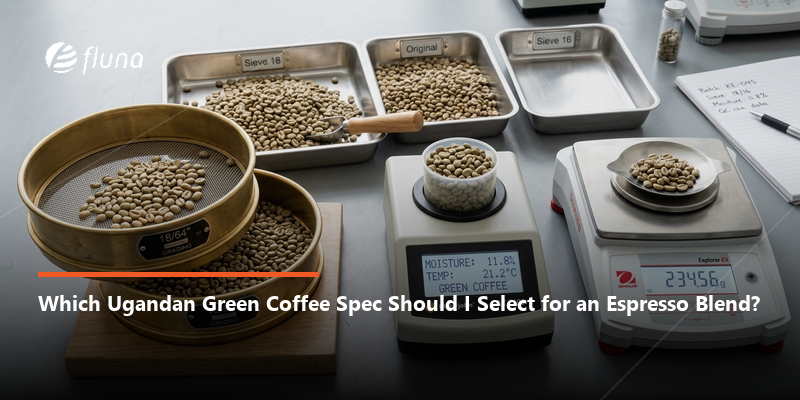
Which Ugandan green coffee spec should I select for an espresso blend: screen size, defect count and moisture targets
By Sandra Nansbuga
Which Ugandan Green Coffee Spec Should I Select for an Espresso Blend?
Engineering a balanced, high-performance espresso blend requires roasters and green coffee procurement managers to establish strict physical green specifications at origin. Because espresso extraction amplifies both aromatic sweetness and underlying physical defects under high pump pressure, bean screen size, defect counts, and moisture stability dictate roast solubility, degassing rates, and crema formation. Selecting the precise Uganda green coffee espresso blend spec allows commercial and specialty roasters to formulate cost-effective blends that deliver rich crema, structured body, and clean chocolate-fruit notes.
Agricultural post-harvest quality standards compiled by the FAO highlight how screen sorting and uniform density prevent conductive scorching in the roasting drum. In coordination with physical grading parameters enforced by the UCDA / MAAIF and green coffee handling guidelines from the Specialty Coffee Association, Ugandan exporters offer tightly specified lots tailored specifically for espresso blending.
Physical Specifications and Uganda Green Coffee Espresso Blend Spec Criteria
When selecting Ugandan green coffee for espresso formulations, roasters primarily choose between three core grades: Robusta Screen 18 Clean Natural, Western High-Altitude Fine Robusta, and washed Bugisu AA Arabica. For traditional Italian-style and commercial European espresso blends, Robusta Screen 18 (sieved over 18/64-inch round perforations, equivalent to 7.14mm) provides dense bean size, maximum soluble solids, and a thick, long-lasting golden crema.
Defect count is a crucial determinant of espresso blend cleanliness. Roasters should specify Clean Natural Grade 1 lots with secondary defect tolerances capped strictly below 1.5% by weight and zero primary defects (such as black beans or sour beans), ensuring that dark or medium-dark espresso roasts do not develop harsh astringency or burnt-rubber notes. For specialty roasters, Western High-Altitude Fine Robusta (cultivated at 1,200m to 1,500m) offers superior cup sweetness, malt complexity, and low defect counts that integrate seamlessly with specialty Arabicas.
Furthermore, moisture content must be tightly specified between 10.5% and 12.0% (with water activity strictly under 0.60 aw). Proper moisture control ensures uniform thermodynamic heat absorption during the Maillard phase, allowing roasters to develop deep caramelized sugars without risking internal core underdevelopment.
Specifying GrainPro-lined burlap export bags guarantees that physical moisture levels remain stable during maritime transit from Mombasa to European roasting facilities. Establishing clear green specs eliminates batch-to-batch roasting variance and protects retail brand reputation.
| Espresso Spec Grade | Screen Size (1/64") | Maximum Defect Tolerance | Target Moisture Range | Recommended Blend Share (%) |
|---|---|---|---|---|
| Robusta Screen 18 Clean Natural | Screen 18+ (>7.14mm, 90% retention) | <1.5% secondary; 0 primary | 10.5% – 12.0% (<0.60 aw) | 20% – 40% (Crema & body anchor) |
| Western Fine Robusta (CWDr) | Screen 17/18 (>6.75mm) | <1.0% secondary; 0 primary | 11.0% – 12.0% (<0.58 aw) | 15% – 30% (Specialty espresso base) |
| Bugisu AA Washed Arabica | Screen 18/19 (>7.20mm) | Zero primary; <3 full secondary | 10.5% – 11.8% (<0.58 aw) | 30% – 60% (Acidity & sweet top notes) |
Actionable Buyer Sourcing Checklist
Define Explicit Screen Retention Thresholds: Specify a minimum 90% retention on Screen 18 sieves in export purchase contracts to prevent smaller Screen 15 beans from roasting unevenly in commercial batches.
Cap Defect Tolerances by Weight: Mandate Clean Natural Grade 1 standards with zero primary insect damage or black beans to protect espresso crema flavor integrity.
Verify Water Activity and Moisture: Require laboratory certificates confirming moisture between 10.5% and 12.0% to guarantee long-term green storage stability and consistent roast momentum.
Calibrate Tri-Origin Blend Ratios: Combine 25% Ugandan Screen 18 Robusta with 45% Bugisu AA Arabica and 30% Brazilian Natural Arabica for a balanced, high-crema espresso blend that excels in milk-based beverages.
Mandate Hermetic GrainPro Protection: Protect green coffee contracts with hermetic inner liners to prevent moisture re-absorption and condensation during ocean shipping to destination ports.
Conduct Pre-Shipment Sample Roasts: Test pre-shipment green samples across high-convective roast profiles to verify that degassing rates and soluble extraction meet commercial espresso standards.
FAQ
Q: Why is Ugandan Robusta Screen 18 preferred for espresso blends?
A: Screen 18 beans have large screen size, high density, and high soluble solid content, which generates abundant, long-lasting espresso crema and a rich dark chocolate foundation.
Q: What is the ideal moisture spec for Ugandan green coffee intended for espresso?
A: The ideal moisture range is 10.5% to 12.0% with water activity below 0.60 aw, ensuring clean Maillard caramelization during roasting and excellent green storage longevity.
Q: How does Bugisu AA complement Robusta in an espresso blend?
A: Bugisu AA adds phosphoric citric brightness, dense cane sugar sweetness, and berry top notes, perfectly balancing the heavy body and rich crema provided by Ugandan Robusta.
Sources: FAO Agricultural Guidelines | UCDA / MAAIF | Specialty Coffee Association