
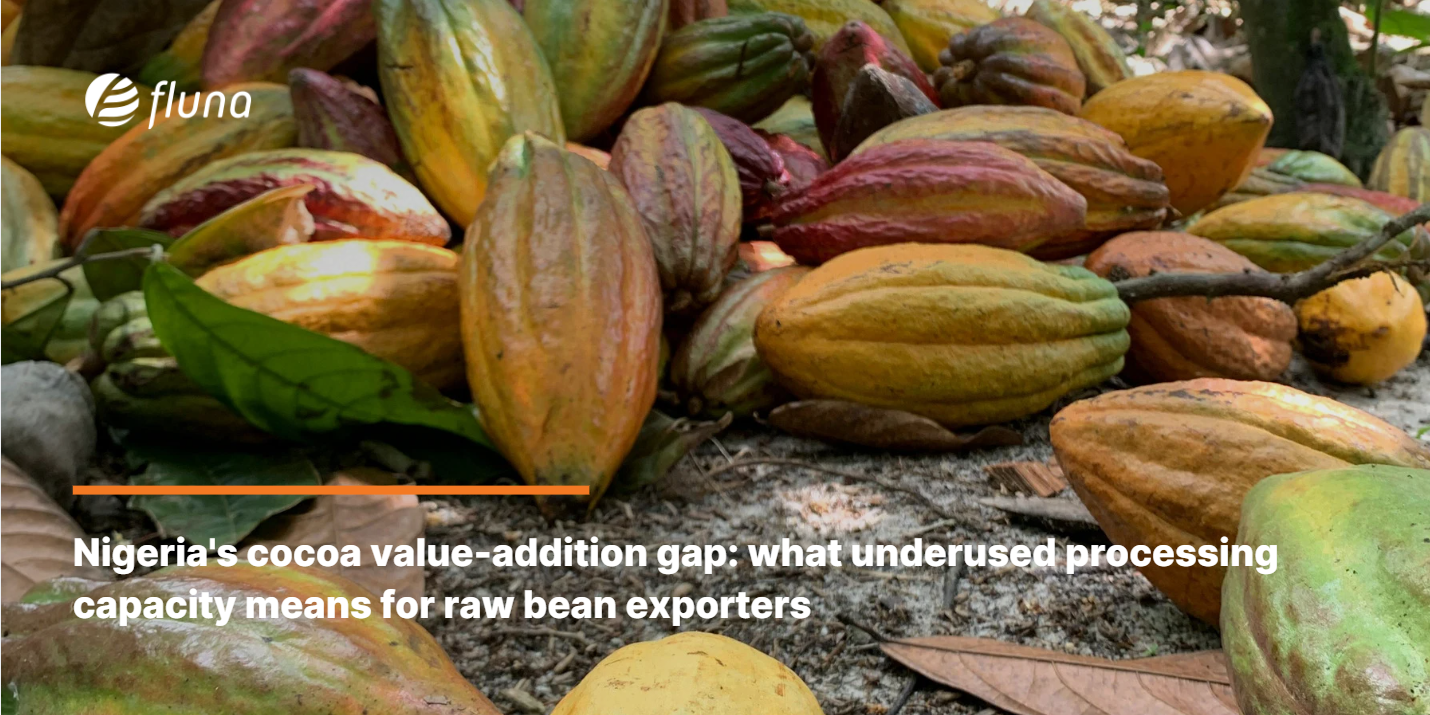
Nigeria's cocoa value-addition gap: what underused processing capacity means for raw bean exporters
By Sandra Nansbuga
Nigeria's cocoa value-addition gap: what underused processing capacity means for raw bean exporters
Nigeria loses about $2bn a year in potential cocoa value because its processing capacity is largely underused, the Federal Government said on 7 October 2026 in Lagos, Vanguard reported. The capacity figure attached to that claim, about 2,000 tonnes a year, does not square with the 120,000 tonnes of grinding capacity the presidency cited in July, Premium Times reported, so buyers should plan around policy direction rather than the headline number.
Agriculture and Food Security Minister Kyari gave the $2bn estimate through the ministry's Deputy Director of Tree Crops, Ajayi Olutobaba, at a two-day Africa Cocoa and Coffee Conference organised by COCEFAAA with the ministry and the Cocoa Research Institute of Nigeria, or CRIN. Kyari put installed cocoa processing capacity at about 2,000 tonnes a year, with only about 30 per cent in use, and said policy was to move Nigeria from producing beans to processing butter, liquor, powder and chocolate locally while keeping the country a reliable cocoa exporter. He framed the goal as value addition rather than an export ban.
At the same event, CRIN's acting Executive Director, Abiodun Adedeji, said Nigerian cocoa yields remain between 250kg and 300kg per hectare a year despite years of seedling distribution, and that the ministry had mandated CRIN to produce and distribute one million improved hybrid seedlings.
Two official statements, three months apart, conflict:
| Attribute | Lagos statement, October 2026 | Abuja summit address, July 2026 |
|---|---|---|
| Capacity figure | about 2,000 tonnes a year | above 120,000 tonnes a year |
| Utilisation stated | about 30 per cent | not stated |
| Attributed to | Agriculture ministry | President's address, via Premium Times |
The two capacity figures differ by a factor of about 60, and a July 2026 Premium Times analysis put Nigerian processing at about 50,000 tonnes against production above 300,000 tonnes. Treat the 2,000-tonne line as unreliable.
The policy backdrop is clearer than the capacity arithmetic. After the Abuja summit prompted talk of an export ban, the ministry clarified in July 2026 that raw cocoa exports would continue as domestic processing expands. Also in July 2026, the Bank of Industry agreed an €85m facility with the European Investment Bank, about 70 per cent of it reserved for cocoa and dairy.
No published figure here is broken down by port, so Lagos volumes cannot be verified; treat the numbers as national aggregates.
What this means for buyers
Raw beans remain Nigeria's cocoa export base. A ministry official reported by Nairametrics on 14 July 2026 said more than 80 per cent of Nigerian cocoa was still exported as raw beans, and the Bank of Industry contrasts about $9,000 a tonne for raw beans with as much as $30,000 a tonne for processed products. A value-addition push that stops short of an export ban changes that mix over years, not this season, so the near-term risk for buyers is competition for beans rather than prohibition.
Three checks are worth building in. Ask whether a quoted lot is backed by beans already aggregated or by an allocation a processor could absorb if grinding rates rise. Track processing volumes rather than announced capacity, given the 60-fold spread in official statements. And keep weight and quality terms explicit: our guides on stating quantity on a green coffee contract and booking new-crop Ugandan coffee show how African origin lots are specified and committed.
FAQ
Q: Has Nigeria banned raw cocoa bean exports?
A: No. In July 2026 the agriculture ministry clarified that raw cocoa exports will continue while domestic processing capacity expands, after the Abuja summit raised speculation about a ban.
Q: How much cocoa processing capacity does Nigeria have?
A: The published figures conflict. The ministry put installed capacity at about 2,000 tonnes a year in October 2026, while the presidency cited annual grinding capacity above 120,000 tonnes and a 70,000-tonne plant under construction at Sagamu in July 2026.
Q: Will more local processing reduce raw beans available for export?
A: No verified source forecasts that. More than 80 per cent of Nigerian cocoa was still exported raw in July 2026, and the €85m Bank of Industry and European Investment Bank facility reserves about 70 per cent for cocoa and dairy.
Sources: Vanguard | Premium Times | Premium Times analysis | Nairametrics