
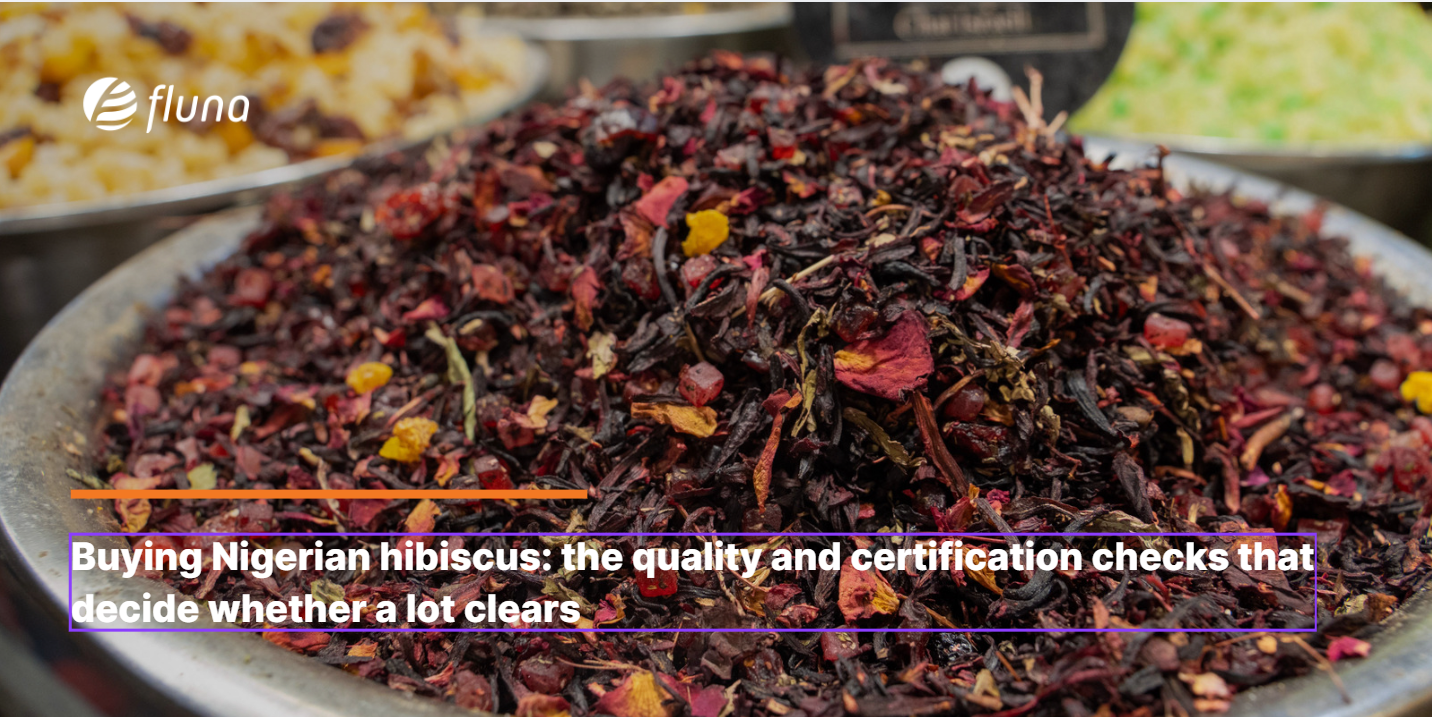
Buying Nigerian hibiscus: the quality and certification checks that decide whether a lot clears
By Sandra Nansbuga
Nigerian hibiscus export: the quality and certification checks that decide whether a lot clears
A Nigerian hibiscus export clears when the lot meets the physical specification agreed with the buyer and travels with valid plant-health certification. The checks that decide it are foreign matter, moisture and colour, plus the phytosanitary and fumigation documents that travel with the consignment.
What does a buyer check on a Nigerian hibiscus lot?
Nigerian trade specifications for dried hibiscus commonly list a moisture maximum of 12 per cent, purity of 95 to 99 per cent, admixture of no more than 2 per cent and a deep wine-red colour, according to the exporter Palmadex. A supplier specification published by Origin Direct sets foreign matter below one per cent, moisture below 11 per cent and pesticide residues within maximum residue levels.
Which documents decide whether a hibiscus export clears?
A hibiscus export moves on three core certificates. Palmadex lists the phytosanitary certificate as mandatory for all agricultural exports, confirming the flowers are free from pests, diseases and contaminants.
| Document | Issuing body | What it confirms |
|---|---|---|
| Phytosanitary certificate | Plant quarantine service | Flowers are free from pests, diseases and contaminants |
| Fumigation certificate | Licensed fumigation companies | Cargo has been fumigated to prevent insect infestation |
| Certificate of origin | Export Promotion Council or Chamber of Commerce | Flowers originate in Nigeria |
Buyers often ask for a clean certificate of inspection from a third party such as SGS, Intertek or Bureau Veritas, which validates quality, moisture, purity and bag weight, and for quality test reports on moisture, purity, colour and microbial content. Those accompany the commercial invoice, packing list, bill of lading and customs export declaration.
Why are Nigerian hibiscus consignments rejected on arrival?
The NAQS places the cause in documentation and handling rather than the crop. In a case reported by Business AM Live, the United States rejected consignments of Nigerian hibiscus because the exporter shipped without certification and did not pass through the quarantine service. NAQS states that the absence of a sanitary and phytosanitary certificate issued after inspection can cause rejection, and that forged or altered certificates, or a changed date, consignment type, weight or volume, are invalid.
NAQS adds two further triggers: concealing an uncertified agricultural item inside a certified consignment, which earns total rejection, and using unapproved fumigants whose residues are detected. Labelling counts too, because the label must describe exactly what appears on the sanitary and phytosanitary certificate.
What residue limits should a hibiscus export be tested against?
Residue limits follow the destination. In the European Union, European Commission rules set a general default maximum residue level of 0.01 mg per kg where a pesticide has no specific MRL, and MRLs apply to the same products after processing, adjusted for dilution or concentration. In the United States, the FDA applies an action level of 20 parts per billion for total aflatoxins in foods under CPG 555.400.
Aflatoxin is a storage problem before it is a shipping problem. Gombella notes that aflatoxins, produced by certain Aspergillus fungi, can develop in hibiscus calyces when elevated moisture, excessive heat and improper storage favour fungal growth, and that trace levels can lead to shipment rejection.
Two Fluna articles sit alongside this one: how to compare quotes from Uganda coffee exporters, and From Deal to Delivery, on the trusted office in Europe that the Fluna Farmer Collective provides for fresh produce.
FAQ
Q: What moisture content should Nigerian hibiscus have for export?
A: Nigerian trade specifications commonly list a maximum of 12 per cent moisture for dried hibiscus flower. Palmadex reports testing moisture at sourcing, cleaning, storage and pre-shipment.
Q: Does dried hibiscus need a fumigation certificate to export from Nigeria?
A: Palmadex lists a fumigation certificate, issued by a licensed fumigation company, as part of the hibiscus export documentation, confirming the cargo has been fumigated to prevent insect infestation. NAQS warns that unapproved fumigants and their residues lead to rejection.
Q: What pesticide residue limit applies to Nigerian hibiscus in the European Union?
A: The European Commission applies a general default maximum residue level of 0.01 mg per kg where a pesticide has no specific MRL. Buyers check individual actives against the EU pesticides database.
Sources: Palmadex | Origin Direct | Palmadex | NAQS | Business AM Live | European Commission | FDA | Gombella