
Ghana Relaunches Free Fertiliser for Cocoa Farmers With Digital Tracking: What Cocoa Buyers Should Watch
By Sandra Nansbuga
Ghana Relaunches Free Fertiliser for Cocoa Farmers With Digital Tracking: What Cocoa Buyers Should Watch
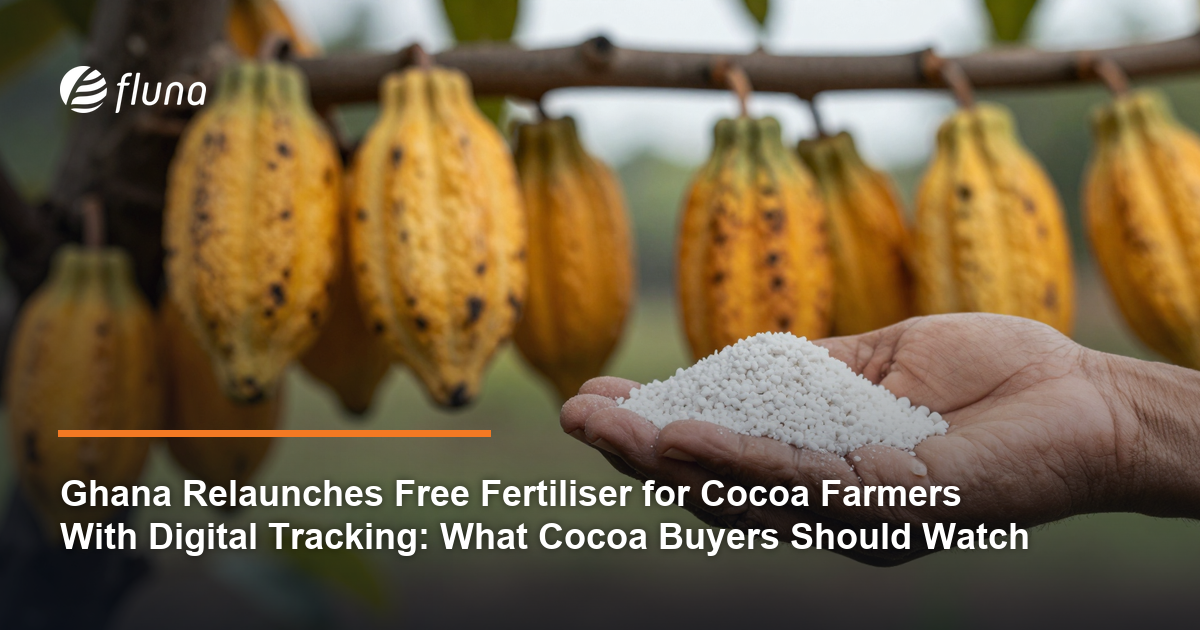
COCOBOD relaunched its free fertiliser distribution programme for Ghanaian cocoa farmers on 10 November 2026, with distribution tied to farmers registered and mapped on its digital Cocoa Management System. Graphic Online reports that 3.5 million bags of granular fertiliser have been purchased and about 1.2 million bags have already been delivered. No yield, output or export result has been reported.
What was announced
Graphic Online reports that the government has also purchased 1.8 million litres of liquid fertiliser, 2.3 million litres of insecticides and 1.5 million kilogrammes of fungicides. COCOBOD board chairman Dr Samuel Ofosu Ampofo announced the purchases at the relaunch in Sefwi Wiawso, Western North Region. He said the programme is meant to address critical constraints on cocoa farmers, improve soil fertility, strengthen tree health and ultimately increase yields.
The Western North Regional Minister, Wilbert Petty Brentum, said fertiliser at no cost would support rehabilitating farms and improve the health and productivity of surviving cocoa trees.
How the tracking is meant to work
COCOBOD chief executive Dr Randy Abbey said the distribution chain is built around a new digital input system that follows every bag or litre of input from the warehouse to the farm. He said every beneficiary must be a registered farmer whose farm has been mapped and captured on the Cocoa Management System, and that identity is verified at the point of collection.
Abbey warned that any officer, buyer or individual found diverting, hoarding, reselling or smuggling the inputs would be dealt with according to the law. Ofosu Ampofo also cautioned against diversion and said enhanced tracking technology has been deployed to monitor distribution from warehouses to farms.
The Ghana News Agency adds that Abbey directed officials of the Cocoa Health and Extension Division to use technology to register farmers, remove middlemen and ensure inputs reach cocoa farmers directly.
The disease context
The Ghana News Agency reports that Abbey expressed concern about cocoa swollen shoot disease in Western North Region, where output has declined from an annual 340,000 metric tonnes to 140,000 metric tonnes. He said COCOBOD is mobilising capital from development banks and private sector partners to rehabilitate diseased farms.
What this means for buyers
The following is practical guidance and the writer's analysis, not a statement by COCOBOD. It applies to buyers and exporters sourcing Ghanaian cocoa.
Sourcing. Treat the relaunch as an announced input programme, not as a supply outcome. Ask Ghanaian suppliers whether the farms behind their lots are registered and mapped on the Cocoa Management System, since COCOBOD has made registration a condition for beneficiaries.
Contract terms. Keep quality, grading and delivery clauses unchanged until results are reported. Do not write fertiliser programme claims into specifications, because no output effect has been stated by any source.
Compliance. COCOBOD has said buyers found diverting, hoarding or reselling inputs face legal action. Buyers dealing with licensed intermediaries should ask counterparties how they keep clear of input handling.
Monitoring. Watch for official updates on delivery progress against the 3.5 million bags purchased, and for any reporting from Western North Region, where disease has been the stated concern.
Related reading: Ghana cocoa bean count and cut test grading sheet and Kenya avocado sea export closure and buyer checks.
FAQ
Q: What did COCOBOD announce on 10 November 2026?
A: According to Graphic Online, COCOBOD relaunched its free fertiliser programme, with 3.5 million bags of granular fertiliser purchased and about 1.2 million delivered, plus liquid fertiliser, insecticides and fungicides.
Q: How is distribution tracked?
A: Abbey said beneficiaries must be registered farmers whose farms are mapped on the Cocoa Management System, with identity verified at collection and inputs followed from warehouse to farm.
Q: Has the programme raised output?
A: No result has been reported. Ofosu Ampofo described higher yields as the programme's intended aim, and no source states a measured effect.
Sources: Graphic Online | Ghana News Agency